
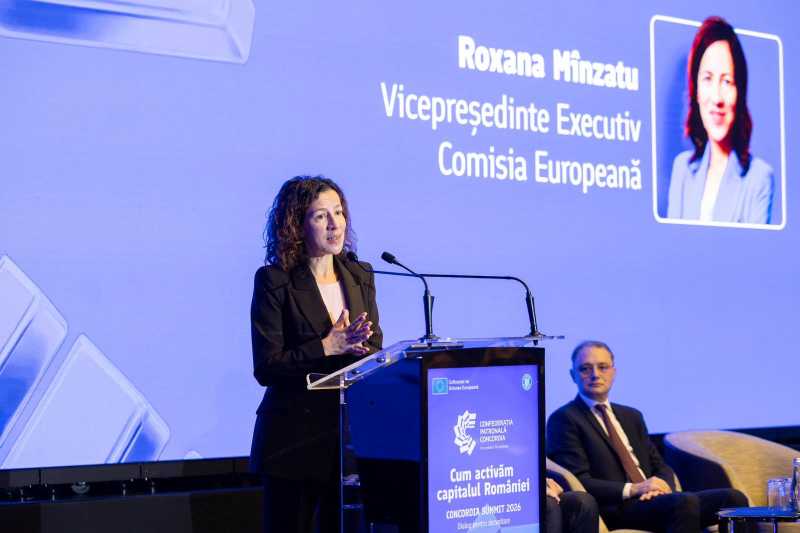
The European Commission’s work is aimed at shaping a solid and competitive future that benefits people, employees and citizens, against a backdrop of considerable economic, security and geopolitical turbulence, European Commission Executive Vice-President for Social Rights and Skills, Quality Jobs and Preparedness Roxana Minzatu said on Friday at the second edition of the Concordia Summit 2026.
Addressing business leaders and employers’ representatives, Minzatu stressed the importance of human capital as a key driver of economic success, referring to former Italian Prime Minister Mario Draghi’s assessment that “European competitiveness today depends less on relative labour costs and more on workers’ knowledge and skills.”
Her central message was that people must be recognised as an essential form of capital alongside financial resources. “Any company seeking to launch and succeed needs both money and human resources,” she said, adding that Romania had managed to achieve economic performance and improve living standards within the EU, with substantial support from European funding.
Minzatu also outlined the European Commission’s latest initiatives to strengthen human capital, particularly the Education Package, launched on November 5, which addresses four major priorities.
The first concerns reversing the accelerating decline in young people’s basic skills. PISA results point to a deterioration in reading, mathematics, science and digital skills across almost the entire European continent, with only a few exceptions, including Ireland and Estonia. The decline has persisted for more than a decade and accelerated after the pandemic. Romania, unfortunately, is among the EU countries experiencing the steepest deterioration, she noted.
The EU is supporting member states through funding, policy guidance and cooperation mechanisms to help schools and teachers prioritise basic skills.
“Regardless of our expectations regarding automation and artificial intelligence in teaching and learning, basic skills will determine the extent to which our citizens, workers and entrepreneurs remain cognitively resilient, capable of critical thinking and able to function in the economy and in a democracy,” Minzatu said.
The second priority is strengthening the teaching profession. Achieving improvements in compulsory education, vocational training and reskilling requires a sufficient and motivated teaching workforce, supported through training and better working conditions. The Commission is encouraging member states to support early-career teachers, reduce administrative burdens in the classroom and help educators manage the use of artificial intelligence in teaching.
The third priority is modernising vocational and technical education, particularly through stronger partnerships between schools and businesses. Mînzatu said the Commission had proposed dedicating a component of the future European Competitiveness Fund to cross-border partnerships between companies and vocational schools, organised along European value chains.
These partnerships would focus on four strategic areas: clean technologies, including renewable energy and electric vehicles; digital technologies and AI; biotechnology; and defence. She also highlighted Romania’s responsibility for modernising its own vocational education system, which has already benefited from substantial EU funding.
The fourth priority concerns artificial intelligence and technology in education. Minzatu noted that the EU had proposed restricting children’s access to social media until the age of 15, citing concerns about addiction and harm to mental health. At the same time, she stressed the need to help both pupils and teachers use AI critically and effectively.
To this end, the Commission has proposed a consortium of member states to develop AI technologies and tools specifically for education. Eight countries have already joined the Digital Education Consortium, which aims to provide schools and teachers with free, accessible tools grounded in European values and data protection standards, while also supporting the development of Europe’s educational technology companies.
Finally, Minzatu pointed out that strengthening human capital was only one part of the Commission’s broader competitiveness agenda.
“We are working on all fronts to improve Europe’s competitiveness. Beyond human capital, this means addressing energy prices, access to raw materials and financing, as well as the fragmentation of EU capital markets and the need to reduce it,” she said.
The second edition of the Concordia Summit 2026 brings together business leaders, policymakers, regulatory and supervisory authorities and European partners to discuss how Romania can turn its strategic geographical position, energy and agricultural resources, and IT industry into investment, exports and well-paid jobs.


