
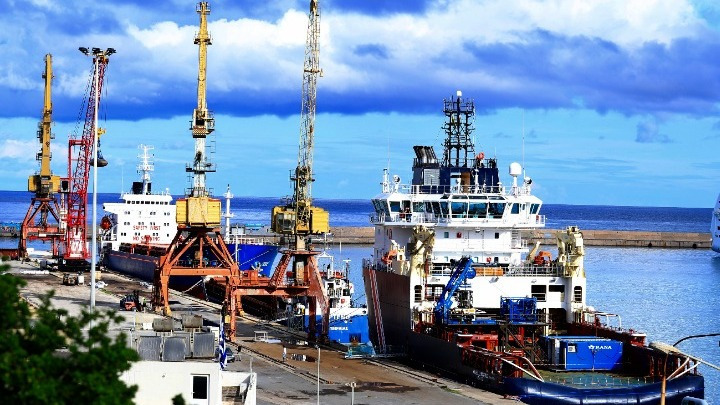
The French-flagged offshore support vessel “Abeille Marengo” arrived at the port of Heraklion in Crete on Tuesday morning, from where it will carry out underwater surveys for the laying of high-voltage direct current (HVDC) submarine cables for the Crete-Cyprus electricity interconnector, known as the Great Sea Interconnector (GSI).
The vessel sailed to Heraklion from Italy and is currently waiting for the official issuance of the required NAVTEX navigational warning, which will specify the maritime area in which the planned operations are to take place.
Navy to be notified 72 hours before surveys begin
The notification of the relevant military and naval authorities before the start of the survey work is becoming a particularly important part of the process.
Under the terms set out in the relevant application, “Abeille Marengo” will notify the Hellenic Navy’s Hydrographic Service, Submarine Command and Naval Aviation Command at least 72 hours before operations begin, and provide updates daily throughout the duration of the work.
The notifications will include precise coordinates, descriptions of the planned operations, required safety distances and any other information necessary to ensure that the surveys are conducted safely.
The notification of local port authorities and vessels passing through the area is also demanded. Passing vessels will be required to maintain a safe distance of at least one nautical mile from the survey vessels.
According to sources, the survey ship is expected to operate under the discreet surveillance of Hellenic Coast Guard patrols and Hellenic Navy units, as part of efforts to monitor and ensure the safety of activities in the area.
How the surveys will be carried out
The underwater surveys have been assigned to Italian company Next Geosolutions Europe SpA, a member of the Marnavi shipping group specialising in geophysical and geotechnical surveys for offshore energy infrastructure. The company was commissioned by French firm Nexans, which is responsible for the manufacture and installation of the Crete-Cyprus electricity interconnector cable.
The surveys will follow the planned cable route between the maritime area of Korakia, in the Heraklion regional unit of Crete, and Cyprus.
The main objective is to map the seabed in detail and record its geological and morphological characteristics, enabling the most suitable route to be selected for the safe laying and protection of the power cables.
Specialist equipment will be used for the task, including a multibeam echo sounder, side-scan sonar, a magnetometer and underwater video systems.
Geotechnical samples will also be collected at depths of up to 700 metres below the sea surface, alongside penetration tests and seabed drilling.
The main challenges stem from the great depths of the eastern Mediterranean, as well as steep underwater slopes and complex seabed formations.
Approval process
The use of the French-flagged “Abeille Marengo” required additional exceptional approval from the relevant departments of the Ministry of Maritime Affairs and the Hellenic Coast Guard.
According to the relevant document, the vessel was deemed necessary because of the demanding technical requirements of the surveys and the lack of suitable Greek-flagged vessels available during the period in question.
The “Abeille Marengo”, which is 73.2 metres long, was built in Norway in 2009 and is equipped with specialist equipment for offshore operations.


