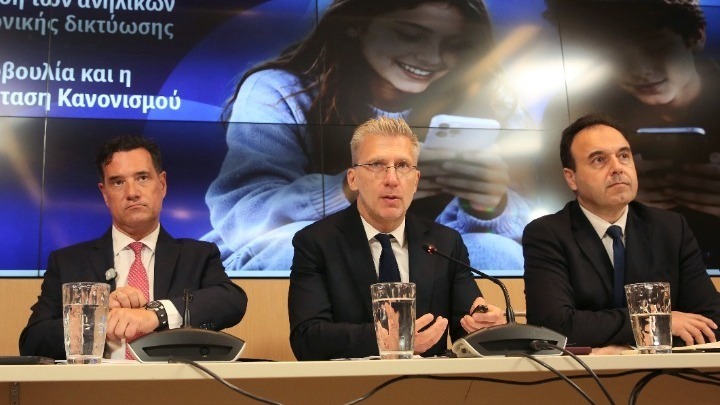
The government presented a bill on Monday providing for an age limit on minors’ access to social media, with implementation set to begin on January 1, 2027, as part of an initiative to protect children from the risks of the digital environment.
Under the proposed legislation, children under the age of 15 will be barred from accessing social media, with platforms responsible for verifying users’ ages, State Minister Akis Skertsos, Health Minister Adonis Georgiadis and Digital Governance and Artificial Intelligence Minister Dimitris Papastergiou announced at an interministerial press conference at the Bodossaki Foundation building.
Papastergiou clarified that, under the age-calculation method to be applied, January 1 of each year will be used as the reference date of birth, aligning age limits with school year groups. On this basis, from January 1, 2027, access to social media will be prohibited for children born in 2013 or later.
Skertsos announced that the bill will be introduced to the competent parliamentary committee on Tuesday, October 13, where a hearing with stakeholders is also scheduled to take place. The government aims to bring the bill before Parliament’s plenary session for a vote on October 22.
Kids Wallet and platform responsibility
A central element of the plan is mandatory age verification using digital tools such as Kids Wallet. As the Digital Governance Minister explained, platforms will be required to use verification mechanisms when they cannot reliably establish a user’s age.
Kids Wallet does not transmit a user’s date of birth to platforms. Instead, it provides a digital signal confirming whether the user is above or below the prescribed age threshold. The aim is to limit the processing of personal data without compromising the reliability of the verification process.
Papastergiou said that when a platform is uncertain about a user’s age, it will be able to display a QR code, which the user can scan through Kids Wallet or Gov.gr Wallet to complete verification.
The minister noted that responsibility will now shift to the platforms themselves, which will have to ensure compliance with the age restriction, rather than leaving parents solely responsible for relying on parental-control applications.
Technical challenges also include the possibility of bypassing restrictions through virtual private networks (VPNs), which can make a connection appear to originate from another country. According to the minister, the government is examining the use of additional indicators, such as a Greek mobile phone number, browser language and IP address, to identify cases requiring further checks.
Papastergiou said the initial focus would be on Instagram, Facebook and TikTok. However, the list of services covered by the regulation is not final and is expected to change.
The government stressed that the measure applies to social media, rather than internet and technology use as a whole. The aim is to limit children’s exposure to harmful content and practices that may encourage excessive use, without excluding them from digital services needed for communication, education and everyday life.
Implementation will be based on the EU’s Digital Services Act (DSA), with breaches subject to the supervisory and enforcement mechanisms provided for under European legislation. As the Digital Governance Minister noted, fines under the DSA can reach up to 6% of a platform’s global annual turnover.
State Minister Akis Skertsos: From individual responsibility to corporate accountability
State Minister Akis Skertsos said the initiative aims to establish a framework of rules for technology companies, ensuring that children’s protection does not depend solely on the decisions made by individual families.
He stressed that platforms collect data on users’ preferences and behaviour and use algorithms to personalise the content they display. According to Skertsos, this practice poses particular risks to minors, who have yet to fully develop their capacity for self-regulation.
He argued that corporate self-regulation is not sufficient and underlined the need for government intervention at both national and European level. At the same time, he noted that the initiative is not directed against technology, which remains important for children’s education, access to information, entertainment and socialisation.
On the European dimension, Skertsos said Greece aims to become the first European country to introduce comparable legislation. He also noted that the Greek proposal had been developed following consultations with the relevant European authorities to ensure compatibility with the existing EU regulatory framework.
Health Minister Adonis Georgiadis: Data on excessive use raise concerns
Health Minister Adonis Georgiadis focused on the impact of social media on children’s mental health, citing research findings on teenagers’ use of digital services.
He said more than half of lower and upper secondary school students began using social media between the ages of 10 and 12, while one in four reported excessive use. According to the figures he presented, 23% of 15-year-olds feel nervous or insecure when they cannot access their mobile phones.
The minister also cited data indicating that 17% of children aged 11 to 15 have experienced online harassment, while one in five 15-year-olds neglects other activities, such as sports and hobbies, because of social media use.
Georgiadis noted that digital addiction does not affect only minors but can also affect adults. However, he stressed that its consequences at a young age can be particularly significant for personality development and social relationships.
He also announced that a programme to tackle digital addiction has been launched through the National Organisation for the Prevention and Treatment of Addictions, using funding from the EU’s NSRF programme. He added that a dedicated helpline, 1145, has been set up to provide support to children, parents and adults dealing with digital addiction and other dependencies.
The European dimension and next steps
The three ministers presented the legislative initiative as a continuation of measures already introduced to protect minors, including a ban on mobile phone use in schools and the development of digital tools to keep children safe.
Skertsos referred to Prime Minister Kyriakos Mitsotakis’s interventions at international and European level, beginning with his speech to the UN General Assembly in September 2024, as well as the Greek government’s initiatives towards the European Commission.
On his part, Digital Governance Minister Dimitris Papastergiou stressed that Greece’s approach is based on the existing European framework for digital services. He also referred to European initiatives currently under development to protect minors, which are expected to complement the existing framework.
The measure’s implementation from January 1, 2027 will mark the next stage of government intervention, with its effectiveness depending on the reliability of age-verification mechanisms, compliance by platforms and cooperation from parents.