
The Department of Antiquities announces the completion of the second excavation season at the Chalcolithic settlement of Erimi Pamboula, which took place between the 25th of June and 24th of July 2026. The excavation was conducted by the National and Kapodistrian University of Athens (NKUA) under the direction of Professor Giorgos Vavouranakis.
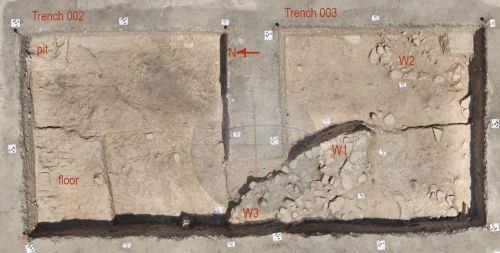
According to the Antiquities Department, this year, the NKUA investigations continued at a close distance from the Dikaios’s original excavation area, uncovering an extensive outdoor space with plaster floor remains, a stone mortar, a plaster hearth, sherd and animal bone groups, and ochre working remains. The ground plan of a circular building, already partly excavated by the Department of Antiquities, was almost completely unearthed, it said. A second wall at a close distance, misidentified as rectilinear in 2025, now seems to belong to another circular building, it notes.
The movable finds include, among others, many pottery sherds, mainly Red-on-White, chipped stone and ground stone tools of various types, picrolite objects (pebbles, half-finished artifacts and beads), clay lumps, seashells and animal bones mainly from deer.
“The pottery so far confirms the dating of the settlement within the Middle to the early Late Chalcolithic period (3500 and 2900/2800 BC)”, the Antiquities Department said.
It notes that the research team included the NKUA adjunct lecturer Ioannis Voskos, post-doctoral researchers, PhD candidates, postgraduate and undergraduate students from the NKUA and the Universities of West Attica, of Heidelberg and Lumiere Lyon II, as well as archaeologists from Cyprus. An Erasmus short blended mobility programme organised by the NKUA and the Cyprus Institute was included in the excavation.
It adds that Associate Professors Evi Margaritis and Efthymia Nikita, and post-doctoral researcher Angelos Hadjikoumis of the Cyprus Institute conducted the study of archaeobotanical material, human and faunal remains, respectively. In addition, post-doctoral researcher Gaia Mustone of the University of Siena studied the chipped stone assemblage and Dr Dimitris Kloukinas (Ministry of Culture – Greece) examined earthen architectural fragments.


