
SARAJEVO, June 15 (FENA) – New criteria for evaluating judicial office holders and the digitalization of judicial services are among the key results of the three-year EU4Justice Phase II project, project participants said, while the Head of the European Union Delegation to Bosnia and Herzegovina, Luigi Soreca, stressed that Bosnia and Herzegovina is lagging behind on its European path due to weaknesses in the rule of law area, which he identified as one of the biggest obstacles to the country’s membership in the European Union.
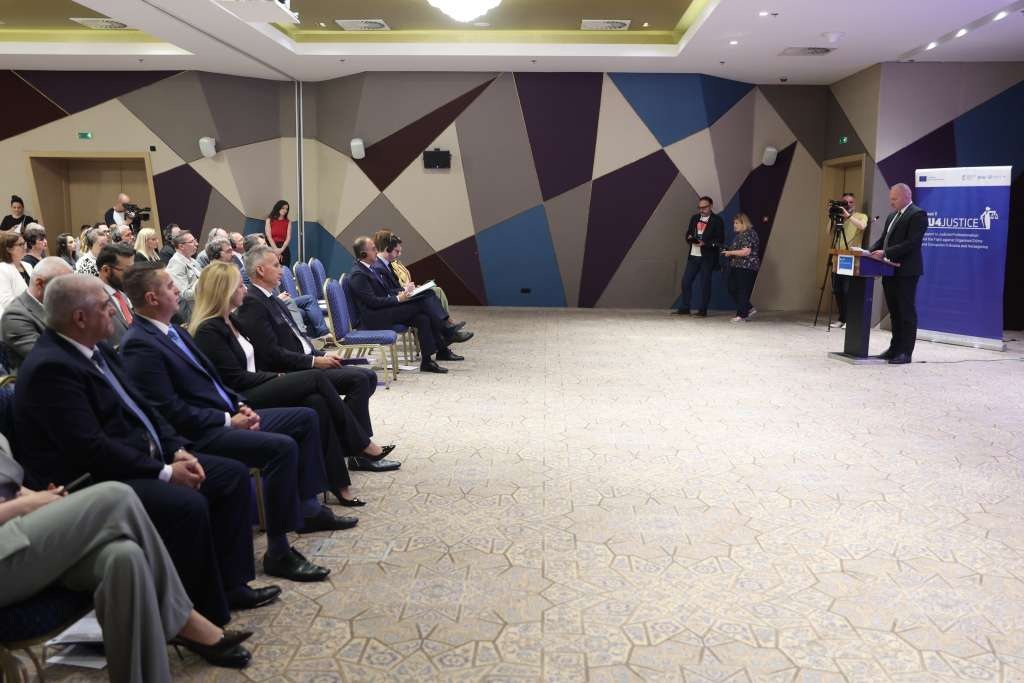
The remarks were made at a ceremony marking the successful completion of the EU4Justice Phase II Project and the presentation of the HJPC BiH Disciplinary Decisions Database, organized today in Sarajevo by the High Judicial and Prosecutorial Council of Bosnia and Herzegovina (HJPC BiH) and the EU4Justice Project.
Phase II is a project funded by the European Union and implemented by a consortium of three public agencies from EU member states: Expertise France as coordinator, the Spanish agency FIAP and the German agency IRZ.
In addition to representatives of the EU Delegation to BiH and the EU4Justice Project, the event was attended by members of the HJPC BiH, court presidents and chief prosecutors in BiH, representatives of justice ministries in BiH, ambassadors of the French Republic and the Kingdom of Spain, as well as representatives of other embassies, international organizations, public institutions and professional associations from BiH.
The first to address the media was HJPC BiH President Sanin Bogunić, who described the three-year project as successful, highlighting that it had delivered significant inputs that would benefit not only the judiciary but also the citizens of BiH.
Speaking about the project’s results, he noted that a disciplinary proceedings database had been created, which he described as extremely useful for both the judiciary and the public. As he explained, it will enable judicial office holders to access consolidated disciplinary practice in one place, with the aim of reducing situations leading to disciplinary responsibility.
As one of the many benefits of the EU4Justice Phase II project, Bogunić highlighted the development of entirely new criteria for evaluating judicial office holders, emphasizing that it was a highly complex process.
He added that substantial funding from partner countries and the European Union had been invested in implementing the project.
“This may be proof that we are truly addressing anomalies within our system,” said Bogunić, adding that many of the proceedings relate to the period before amendments to the Law on the High Judicial and Prosecutorial Council concerning integrity provisions.
Bogunić also addressed the fact that the HJPC had amended the rulebook on external asset monitoring, over which the EU announced the possibility of suspending funding for the institution.
“The High Judicial and Prosecutorial Council, at least this composition of the Council and its leadership, is always ready for dialogue. We should be partners, but partnership implies listening to arguments from both sides,” he said.
He rejected claims of conflict between the judiciary and the EU Delegation.
Head of the EU Delegation to BiH and EU Special Representative Luigi Soreca then addressed the media, emphasizing that reforms aimed at strengthening the rule of law are key in the EU accession process, not only from the perspective of fundamental rights but also for creating a favorable environment for business and investment.
As a concrete result of the project, he highlighted the digitalization of judicial services, explaining that a significant number of courts in BiH now issue digital certificates confirming that no criminal proceedings are being conducted against individuals.
He also referred to the current situation in the EU, noting that the Union is ready for a new wave of enlargement for the first time since 2013, with Montenegro currently preparing its accession agreement while other countries in the region are also making significant progress.
In that context, he emphasized that BiH is falling behind, particularly due to weaknesses in the area of the rule of law, which he described as one of the biggest obstacles on its European path.
He specifically highlighted the current political moment, stressing that BiH has an opportunity this week to make progress by adopting two important laws – the Law on the HJPC BiH and the Law on Courts – which are expected to be on the agenda of the House of Peoples.
He emphasized the EU’s readiness to continue cooperation with domestic institutions.
“At the same time, it is clear that continued support will depend on the alignment of BiH’s practices and legislation with European legislation and standards, given that BiH is a candidate country for EU membership,” he stressed.
He concluded that their only interest is protecting the rights and interests of BiH citizens, adding that the more transparent and efficient the judiciary is, the better protected citizens’ rights and interests will be.
French Ambassador to BiH François Delmas said that France had made available its judges, experts and expertise in European law as one of the EU’s founding members.
He emphasized that together with the EU Delegation, a broader European team had been brought together through the Team Europe concept, including other partners, adding that this is a long-term engagement that will continue.
Speaking about the achieved results, he noted significant progress, especially through the establishment of an asset transparency mechanism for judges and prosecutors, stressing that it is now crucial to ensure its proper and sustainable implementation.
He concluded that this area is essential for BiH’s European path and requires full commitment from all relevant actors, especially the HJPC.
Spanish Ambassador to BiH Maria Molina Alvarez de Toledo said that the project is based on the belief that the rule of law and judicial reform are essential for every democratic society, its citizens and BiH’s European future, emphasizing that all EU member states remain committed to that goal.
“We are here for you and you can count on our continued support,” the ambassador said.
During its implementation, the project supported alignment of the judicial system in BiH with European standards and the EU acquis, focusing on strengthening the rule of law, particularly through improving judicial independence, quality, integrity, professionalism and accountability. Support was also provided to competent authorities in combating organized crime and corruption.
The key beneficiaries of the project were the HJPC BiH, the Prosecutor’s Office of BiH and the Ministry of Justice of BiH.


