
Charlottenburg Hunting Museum – a forest story from Count Winphen in Romania’s unique circular village
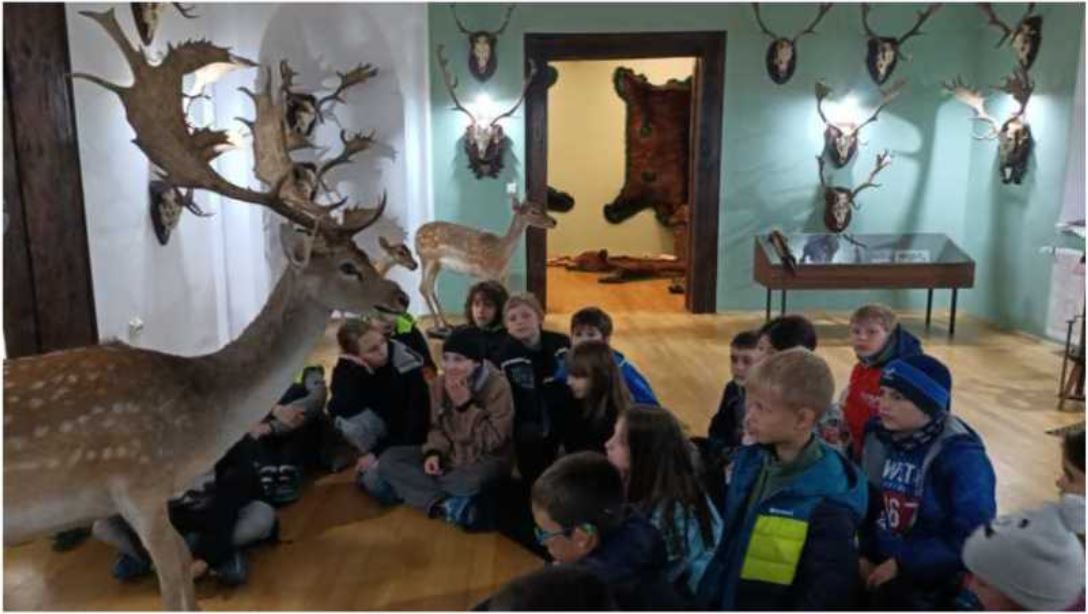
A century and a half ago, Count Sigfrid Winphen set out to enrich the Charlottenburg forest with select tree species and remarkable red deer (Cervus elaphus) stags and European fallow deer (Dama dama) bucks brought from Bohemia, Austria, and Serbia, that were later used to populate other forests across Romania, where deer had previously been absent.
In the 19th century, the Count enclosed the 1,200-hectare forest to protect its flora and fauna, creating a splendid, safe retreat for the aristocracy of the time, where hunting parties were organised.
To shield the village from deer herds, Winphen also fenced the settlement, preserving its present circular shape – a unique ring formation in Romania, now declared a natural monument.
In such a place, it was only natural that a museum of nature should emerge – the Charlottenburg Hunting Museum (MCC, 1904), which was renovated and reopened to the public in 2014 in its current form. The museum is managed by the Timisoara Forestry District of the Timis Forestry Directorate.
Mihaela Oana Bojina, museographer at MCC, told AGERPRES that after World War I, the Charlottenburg park became a royal estate, and following World War II, it was taken over by the communist authorities.
‘Sigfrid von Winphen was married to Anastasia, daughter of Baron George Simon. He fenced the first 18 hectares of forest in 1902, provided work for the villagers, and built the most imposing building, which now houses the museum. It served as a Forestry District office (1920), later becoming the Royal Hunting Forestry District, the Green House (1931), and functioned as such until 1948. (…) The museum as we know it today opened in 2014. In 1902, only a few deer stags were brought here; by 1904 the forest-park held most of the specimens. It has always been a jewel of Banat. The museum adds value to the site. We welcome children who consider this their museum, forestry, architecture and biology students, and parents accompanying children who visit with school groups,’ explained Mihaela Oana Bojinca, a teacher of ecological education and biology.
Visitors to the museum can see 263 exhibits – a true treasury of nature – including hunting photographs and trophy collections awarded gold medals at international competitions. The collection features stags, wild boars, bears, chamois, smaller furred animals, wolves, deer, martens, otters, partridges, and many others.
As the stag is the star of the museum, the ‘fallow deer buck house’ is a key display, while the most valuable exhibit is a bear weighing over 350 kilograms, with a massive pelt that has won multiple international gold medals and is now fondly touched by visiting children.
‘The museum’s collection consists of all 263 exhibits. The main focus is the Fallow Deer Buck House, as in 1902 the first European fallow deer were brought to Romania, and from here the species spread across the country. Red deer stags were brought from Subotica (Serbia), Germany, Austria, and Bohemia. The museum is renowned for its fallow deer buck trophies, as well as red deer, chamois, and wild boar tusks. We have mounted animals, bear trophies. Out of 263 exhibits, 79 are on loan from our partner museum, the Carpathian Posada Hunting Museum. All exhibits are highly valuable, eligible for international competitions with CIC points allowing gold, silver, and bronze awards. Some specimens belonged to the Verbitchi family, who managed the Charlottenburg hunting park during King Michael I’s reign. We have trophies dating from 1920, 1925, and 1930,’ museum curator Mihaela Bojinca recounted.
Each exhibit is accompanied by a conservation and detailed record sheet.
‘I believe the most valuable trophies are the bears, as those three bear pelts have gold medals; each animal weighed around 350 kilograms. Valuable too are the red deer stag trophies, also gold and silver medalled,’ she noted.
The Charlottenburg Hunting Museum collections include: Selection roe deer trophies (6), Fauna of Romania (27), Home at the Fallow deer buck (36), Patents and medals (4), Hunting licences (2), Paintings by Stefan Popa Popas (3), Wild boar tusks from Banat (20), Commemorative medals (3), Mouflon from Scrovistea (4), Red deer stag trophies (10), From the Romanian mountains (9), Hunting through time (109), From the Count’s era (1), Stefan Covaci collection (5), Adam Craciunescu collection (3), Petre Gargarea collection (67).
The museographer emphasises that the museum’s role is not merely to amass exhibits, but to make them accessible to the public and educate children – all for the entry price of seven lei per day.
‘Where else can you get education for seven lei a day? That’s the ticket price, and with it children enjoy a full day of experiments, ecological games, forest excursions, and safe guided walks. We provide ecological education with our rangers, and run projects like Mobile Hunting Museum’, ‘Closer to Museum and Nature’, ‘Museum Stories and Park Tales’, ‘Discover the Forest with Us’, ‘Eco-Museum – a project of engagement’, and ‘Chatting with Nature’,’ the museum curator said.
Children also learn the importance of hunting: ‘It is not about killing animals, but maintaining ecological balance. We only hunt minimally, old or sick specimens; we do not take mothers and young. That’s why mouflon were introduced to the hunting park in the last 20 years, as they cannot defend themselves against wild boar. Here they are protected,’ Mihaela Bojinca explained.
December promises a rich programme for children: 2 December marks MCC Day, celebrating 11 years since its reopening in its current form and 123 years since its foundation. Further activities will be held on 11, 15, 16, 17, and 18 December. AGERPRES (RO – writing by: Otilia Halunga; EN – writing by: Simona Iacob)


