
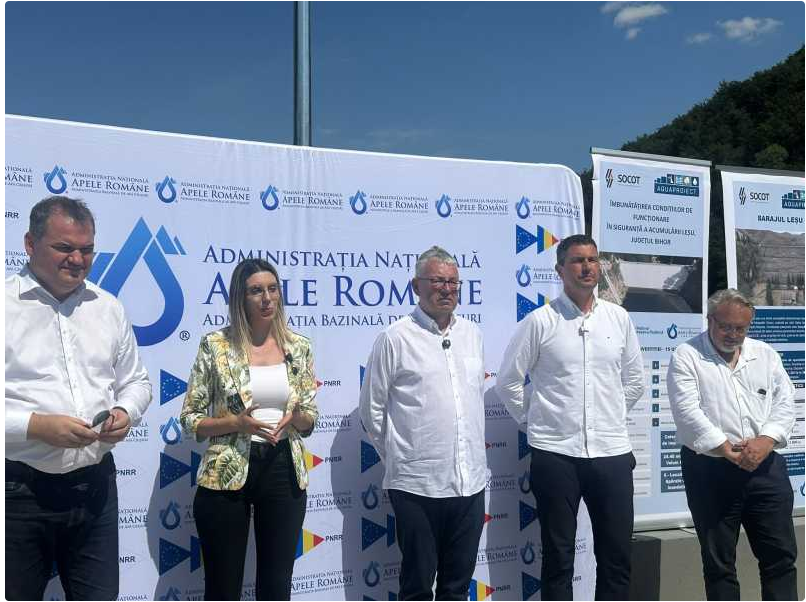
Romania’s 2026 budget for works on dams has increased five times to RON 250 million, and three consolidation projects that lost funding under the National Recovery and Resilience Plan (NRRP) will be supported by national funds, Minister of the Environment Diana Buzoianu said on August 17 at the completion of the rehabilitation works of the Lesu Dam in Bihor County.
The event was also attended by Deputy Prime Minister Tanczos Barna and Deputy Director General of the National Administration Romanian Waters (ANAR) Sorin Randasu, who underscored the need to continue investments in hydrotechnical infrastructure.
Minister Buzoianu said that the government will provide national funds for the works on the consolidation dams at Lacul Rosu, Frumoasa and Surduc, projects eliminated by the European Commission from the NRRP funding because they were not sufficiently advanced, although they had the necessary documentation to start the works.
“They will also be financed, so that the story of Lesu will not be a single story, but will be replicated in other parts of the country,” Buzoianu said.
Also, she announced the allocation of the necessary funds for two polders, Tucea and Rovinari, which risked losing European funding.
The statements were made on August 17 at the Lesu Dam, where the rehabilitation works were completed, a unique project in Romania in that it was the only one financed under NRRP and presented by the minister of the environment as a model for future investments in hydrotechnical infrastructure.
“The Lesu Dam is not only an example of a safety work, essential for access to water, it is also a dam that shows how investments at the highest level of importance can be combined with the environmental mission,” said Buzoianu.
Deputy Prime Minister Tanczos Barna said that the Lesu project is an exception in the context of the implementation of the NRRP, given that ANAR had over EUR 500 million available for projects in the field of water, an important part of the funds being lost.
“ANAR had over EUR 500 million under PNRR for such projects. Dams, permanent and non-permanent polders, facilities and the like (…). Some of them were done, others were not done and the money was lost. But I don’t want to spoil the festive moment,” said Tanczos.
He added that the beneficiary institutions of the NRRP received in 2021 “a historic chance” to make the necessary investments for the communities, considering that the current period should have been marked by more receipts of completed projects.
In his turn, the deputy general director of ANAR, Sorin Randasu, said that the experience gained in Lesu must be capitalised on to accelerate the other investments in the country’s water management infrastructure, and that the experience of this project must be exported to the other water basin administrations, especially for the rehabilitation of dams and the provision of water resources.
“That is what I expect from my other colleagues, from all the water basin administrations, to promote what is left to us, to fight for these projects,” said Randasu.
He also noted the international nature of the Lesu project, on which specialists from Romania, Hungary, Italy, France, the Netherlands and North Macedonia worked, considering that it is important to collaborate with experts from other countries when necessary.


