
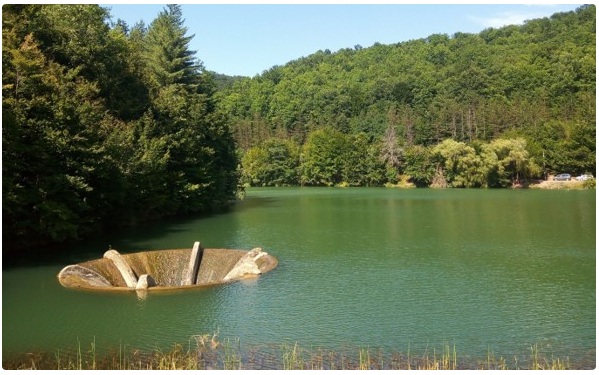
The Dobresti local administration plans to turn Lake Vida – one of Romania’s most distinctive lakes – into a regional hub for active and sustainable rural tourism, through a project worth €4 million, following the completion of major desilting works.
Mayor Florin Copos told AGERPRES that the first development steps have already been taken. “We began desilting the lake last year. The cleaning and expansion works were completed before the winter holidays, and we have submitted the funding request for the technical-economic documentation. We want to create the Vida Lake leisure area, about 10,000 square meters, a EUR 4-million project,” he said.
The project aims to highlight the lake’s spectacular features – its dam and circular spillway, unique in Romania – through discreet, landscape-integrated infrastructure using natural materials. Covering nearly six hectares, Lake Vida was built in 1967 as a rock-fill dam serving former bauxite mines. Its funnel-shaped overflow, known locally as the “whirlpool”, has become its main attraction.
Plans include a multifunctional wooden pontoon for boats and swimming areas, water slides, a zipline, a wooden promenade, fishing huts inspired by local architecture, natural beach zones, pavilions and viewing platforms. An educational trail on the lake’s formation and biodiversity will be created, along with a cycling and running circuit linked to routes in the Padurea Craiului area. Auxiliary buildings will follow high energy-efficiency standards, with photovoltaic systems.
According to the project description, the intervention will turn Lake Vida into “a regional landmark for sustainable rural tourism, capable of extending visitor stays and stimulating the local economy.”
The tourism initiative follows one of the most technically demanding desilting projects in the region, financed through a RON 14.5-million EU-funded operation, part of a wider 36.5-million-lei programme run by the Bihor County Council with several partner communes.
Daniel Fortiu, administrator of Vest Build, said the works required removing up to 300,000 cubic meters of sediment using specialized machinery, including three amphibious excavators, ten long-boom excavators and special dump trucks. The material was deposited on a 2.5-hectare site designated for a future forest, where a 700-meter protection dike was built.
The lake itself has nearly doubled in length – from about 500 meters to roughly one kilometer – after excavation. Additional works included a 1.9-kilometer access road to the camping area, four culverts and 400 meters of shoreline stabilization with gabions.
“It was a very difficult job, both technically and because of the terrain,” Fortiu said, noting that amphibious excavators had to be brought from other counties because such equipment is rarely used outside the Danube Delta or irrigation canals.
Mayor Copos said the overall investment is crucial both for environmental protection and for the area’s tourism development.


