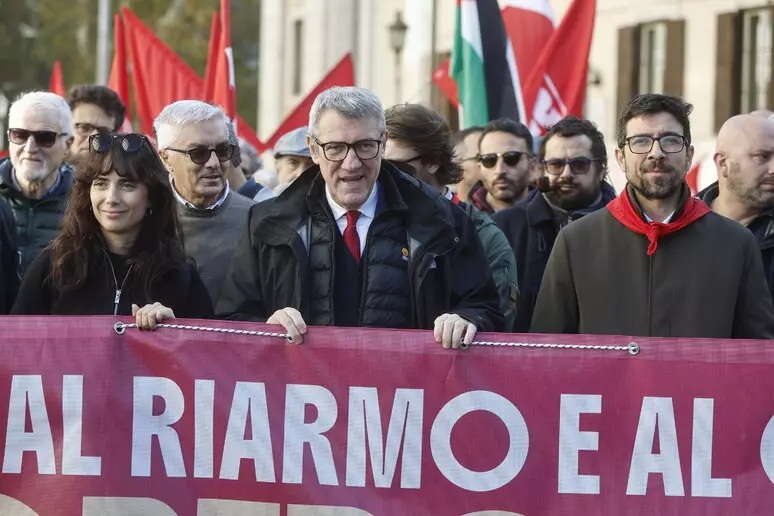
In a general strike across Italy, workers on Friday took to the streets, participating in protests organized by the CGIL and the Cobas trade unions, and students too part in another Europe-wide student mobilization, against the government, its 2027 budget bill, soaring living costs and the state of Italy’s schools and education system, among other things.
In Rome, the CGIL-led march saw its leader Maurizio Landini at the forefront.
“There are more than a million of us across 100 town squares,” said the head of Italy’s biggest and most leftwing union.
“We will not stop; we are the majority in this country”.
“It’s an incredible sight.
There are well over a million of us across more than a hundred town squares” organized throughout Italy for the general strike, said Landini as he began his concluding speech at the demonstration in Rome.
“The squares are full, and people of all generations are present—this is a day that doesn’t divide, but unites.
“A hundred squares filled with the hope for change.
“The government seems a bit confused,” Landini stated.
“Deep down, they know as well as anyone that this budget is disgusting.” Later in the day, Landini said the strike had brought out some 1.5 million people in over 100 cities and towns across Italy, with a 60% strike participation by workers.
“It has been a wonderful day of extraordinary participation,” said Landini, commenting on today’s mobilization.
According to the union’s latest update, 1.5 million people—including workers, students, and pensioners—took to the streets in over 100 cities to support the general strike called by the confederation under the slogan “The future is now.” Furthermore, “based on the data received so far, the average national participation in the strike, across both public and private sectors, stands at 60%.
“Even after a great day like today, if there is no response, we will not stop. We will press on and continue with our mobilizations in the streets,” Landini added.
Centre-left opposition Democratic Party (PD) secretary Elly Schlein and other centre-left leaders were also present at the CGIL-led march in Rome, saying “we are here to defend the Constitution”.
Thousands gathered in Milan, Naples, Genoa, Bologna, Bari, and Turin—where a demonstration involving workers, students, and various grassroots, radical, and university-based movements (including groups linked to anticapitalist squat Askatasuna) was staged.
The general strike saw workers and students take to the streets against Premier Giorgia Meloni’s government, the 2027 budget bill, run-down schools, cuts to education and healthcare, rearmament and hikes in defence spendings, wars, the rising cost of living and unaffordable rents.
Landini also declared: “Listen to the people in the streets—we will not stop.” Disruptions hit schools, the healthcare sector, and public transport.
But air and rail travel were excluded from the strike.
The general strike was a 24-hour action affecting all public and private sectors—from education and healthcare to local public transport, as well as ports and taxi services.
Operations for buses, trams, and subways were subject to locally established “guaranteed service” windows; certain transport companies are also exempt (including ATM in Milan, ATVO in Venice, ANM in Naples, and AMTAB in Bari).
“Even after a day like today—which, from the very start, has proven to be a truly significant success—we will not stop. We will keep going in the days ahead and continue our mobilizations in public squares,” declared Landini, speaking from the march in Rome and calling on “the entire political establishment” to listen.
“Today shows that people want to be heard; they are asking to participate and demanding answers to their needs,” said the CGIL leader.
“Therefore, I believe the entire political establishment must pay close attention and listen to what is happening in the country—and what is happening in Europe,” he added.
The strike was peaceful, and the student protests were largely so, in contrast to a previous one a month ago that saw extensive youth street violence in Milan.
But there were some incidents of violent protest.
Tensions flared and scuffles broke out between police and activist groups in Bologna, just steps away from the headquarters of Confindustria Emilia.
In the Emilian capital, officers in riot gear pushed back a group of protesters who, carrying smoke bombs and banners, had attempted to break through a security cordon blocking the street.
Several police charges took place, and the protesters were pushed back.
The Bologna march later ended peacefully.
Meanwhile in Genoa, students occupied the city university at the end of a march organized by Osa (Dare) and Cambiare Rotta (Change Direction).
The young people shouted slogans and lit smoke flares inside the atrium.
In Rome, meanwhile, firecrackers, bottles and other objects were thrown at the Ministry of Education and Merit.
Firecrackers and a barrage of glass bottles—along with helmets and a road sign—were thrown at the Ministry of Education on Viale Trastevere in Rome, an area secured by law enforcement.
Students participating in a march reached the Ministry, chanting slogans against the Minister of Education, Giuseppe Valditara.
Amidst the barrage of firecrackers, glass bottles, helmets, and e-scooters hurled at the police officers guarding the Ministry, two students—their faces uncovered—sat down among the police.
With their faces still exposed, they provocatively invited the agitators to strike them as well, signaling their dissent against the violent turn the protest had taken.
The gesture did not go over well with the crowd; someone shouted at them, “This isn’t a theater!” This was in stark contrast to the shocking scenes of rioting and looting by youths in the Lombard capital on the weekend of October 17-18.