
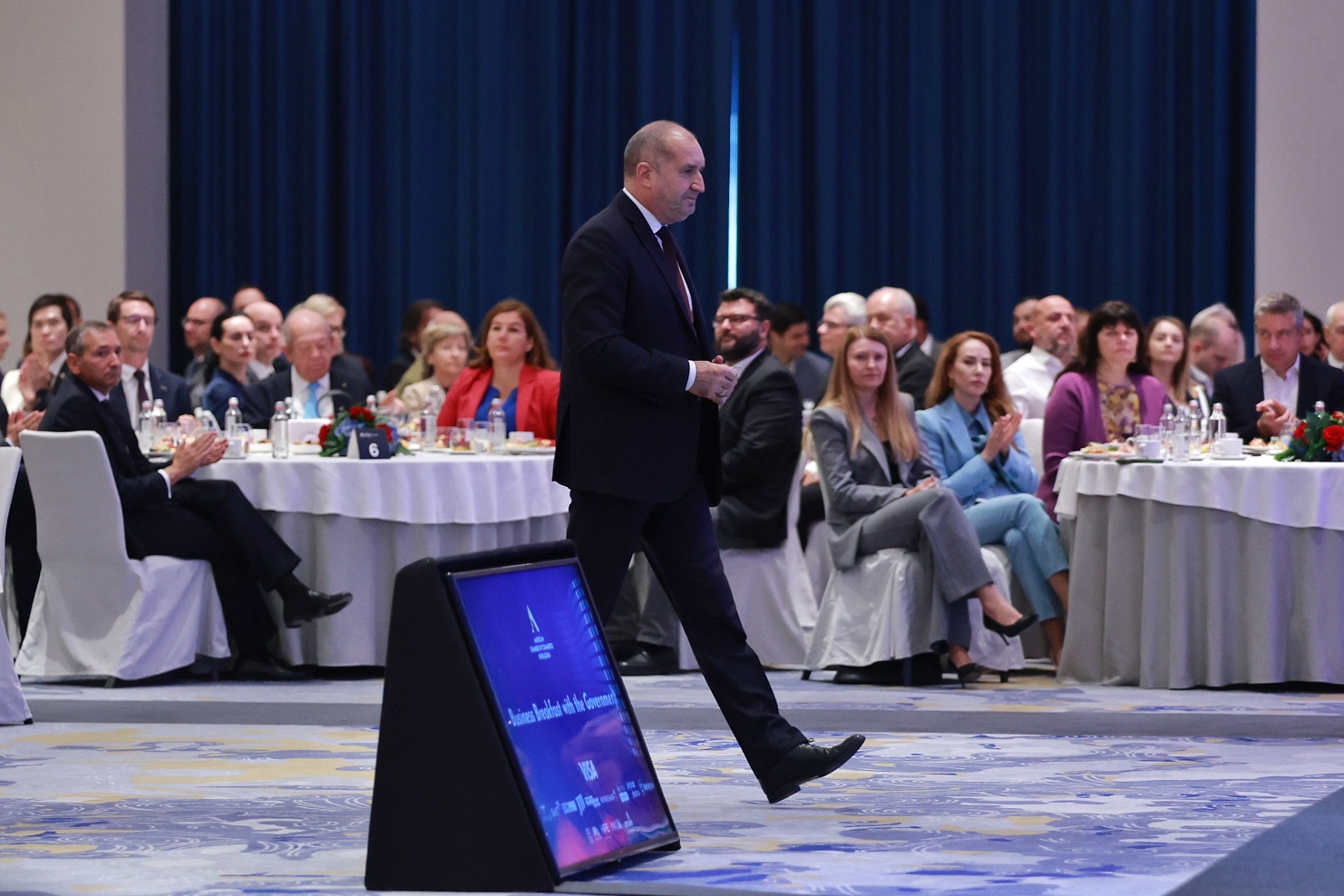
At a business meeting with members of the American Chamber of Commerce in Bulgaria (AmCham Bulgaria) on Monday, Prime Minister Rumen Radev called for US investment in large-scale computing centres, artificial intelligence factories, robotics, mechatronics and semiconductor manufacturing.
Held at the Grand Hotel Millennium Sofia, the traditional AmCham Business Breakfast brought together government representatives and members of the business community for a dialogue on economic cooperation between Bulgaria and the United States.
Radev said all prerequisites were in place for deepening and expanding cooperation between Bulgaria and the US, pointing to the country’s technological capacity, its strategic partnership with the US and what he described as the government’s political will to expand bilateral relations. He said these factors should lead to a breakthrough in new areas of economic cooperation, particularly in cutting-edge technologies.
The Prime Minister said bilateral trade had grown by 40% last year, which he described as evidence of the strong momentum in economic relations. He also highlighted traditional areas of cooperation, including security and defence, the modernisation of the Bulgarian armed forces, joint training and exercises, energy, the industrial base and education.
Radev said Bulgaria was ready to transport significantly larger quantities of US liquefied natural gas to Central and Eastern European countries, in the context of the planned 2027 ban on the transit of Russian hydrocarbons. He said Bulgaria had the necessary capacity and infrastructure, as well as access to infrastructure in neighbouring Greece and Türkiye.
According to Radev, talks are also under way on pooling the region’s natural gas needs in order to strengthen its negotiating position with US companies and secure better terms and prices.
He also highlighted cooperation with the US on increasing the capacity of Bulgaria’s electricity transmission network in preparation for future green energy corridors carrying electricity from North Africa and the Caucasus region. Bulgaria’s secure, high-capacity and reliable energy network, as well as its growing share of renewable energy and available energy surplus, were among the country’s advantages for attracting investment in data centres, he said.
Radev also pointed to Bulgaria’s potential as an energy-storage hub for Central and Eastern Europe and said he believed a potential investment by US company Tesla could represent another breakthrough.
The Prime Minister described the government’s policy of attracting foreign investment in cutting-edge technologies as “aggressive”.


