
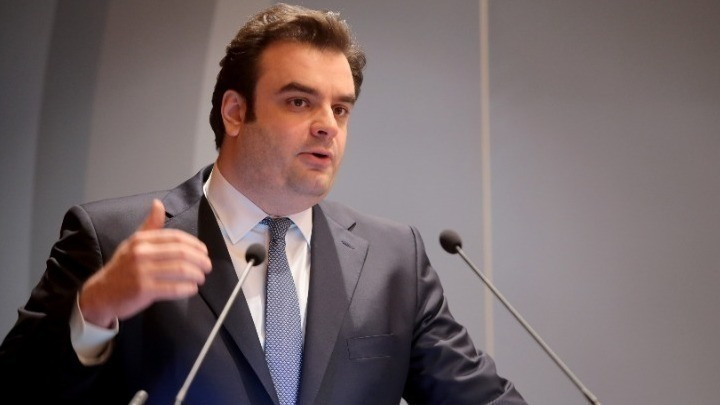
Eurogroup President and National Economy and Finance Minister Kyriakos Pierrakakis on Tuesday stressed that barriers between European Union member-states must be eliminated for a stronger Europe, while addressing an event in Germany co-organised by the Hertie School in Berlin and the Jacques Delors Institute, entitled “Where will Europe’s future growth come from?”.
“The cost of ‘non-Europe’ will be greater,” Pierrakakis emphasised, noting that this will ultimately benefit everyone. He also emphasised the pivotal role of technology in every 21st-century policy and referred to the Greek “success story” and the lessons that can be drawn from it, while noting that “reforms deliver”. He stressed that Germany was essential to the European Union, which needed Germany, just as Germany needed the EU.
Pierrakakis highlighted the importance of unlocking the EU’s growth potential, while outlining the obstacles in this path:
“We agreed that Europe would benefit if we achieved greater scale and removed barriers. At some point, however, in the individual discussions in each policy area – whether energy, banking or capital markets – a ‘but’ would emerge. And that ‘but’ was the national asterisk,” the minister said.
While national concerns were legitimate, he added, changes in the external environment and circumstances have also altered the calculations of member states.
“There is now a recognition that the cost of ‘non-Europe’ is greater,” he said, expressing his optimism about the progress that can be achieved on all the individual issues on the agenda through the implementation of the proposals contained in the Mario Draghi and Letta reports.
Pierrakakis highlighted the crucial importance of the Savings and Investment Union, noting that greater harmonisation of capital market supervision was needed to remove the barriers that still exist between EU member-states.
“The IMF has calculated that the barriers between member states in the services sector are equivalent to hidden tariffs of 110%. In manufacturing, the corresponding figure is 44%. Therefore, not having a comparable level of common supervisory capacity is like having the euro without a strong European Central Bank,” he added. At the same time, however, he stressed that Europe must make progress on all the issues outlined in Draghi’s report, whether this concerns integrating energy markets, integrating telecommunications markets – an area in which Europe has historically enjoyed a technological advantage – or technology more broadly.
he minister also referred to the use of technology, saying that this must be at the heart of policies since it affects both budgets and societies, describing it as “the central, horizontal, unifying element of all policies.”
Asked whether he was concerned about rising debt, the Eurogroup president said the issue concerned him but did not cause him to panic. He referred to temporary external factors – such as the crisis in the Strait of Hormuz – that are putting additional pressure on the situation in Europe, while also pointing to the stronger performance of European markets compared with markets outside Europe. He further stressed that, although the euro crisis left the corresponding European institutions in its wake, they cannot substitute for national strategies. Fiscal stability, targeted fiscal policies and growth strategies are, by definition, necessary, he said, adding that “every euro must count”.
Asked what message Greece’s “success story” could offer other member states, such as Germany, Pierrakakis said he did not believe that one country could teach another, but that it could potentially serve as an inspiration. Regarding Germany, specifically, he noted that Europe and Germany need each other and referred to the package of reforms being pursued by Berlin, stressing: “If there is one lesson of inspiration from Greece, it is that reforms deliver.” Responding to a related question, the minister also made clear that he did not believe in the old divisions between “frugal” and “ profligate” member states. “We actually have a very strong example of this in the Greek budget,” he said.
As a key priority for future European policy, Pierrakakis highlighted the need to manage major issues at European level, particularly in the field of investment. “It would not make as much sense, for example, to talk about a Greek investment ecosystem for start-ups. It would make more sense to have a pan-European ecosystem of this kind,” he explained. Asked about European public goods, he pointed to defence and energy, stressing that the elements of saving and innovation should coexist. He cited the European Space Agency as an example of effectiveness.
The head of the Eurogroup also argued that the EU should not focus investment on fields in which it is not a leading player, but should regulate them. Rather than Europe attempting to compete with giants such as those in the US, it would be more appropriate for it to exercise its sovereignty and impose rules governing the operation of these companies on its territory, he explained. “Either you own something or you control it,” he said, adding that Europe has strong players that should be equipped and supported so that they can take a leading role in areas where they have an advantage.
As part of his visit to Berlin on Tuesday, the Greek minister is due to meet German Chancellor Friedrich Merz and Vice Chancellor and Finance Minister Lars Klingbeil. Their talks will focus on the state and prospects of the European economy, with particular emphasis on the challenges facing growth and competitiveness. Particular weight will be given to fiscal coordination among eurozone countries, while further European financial integration will also be discussed, through policies aimed at deepening the Banking Union and advancing the Savings and Investment Union.


