
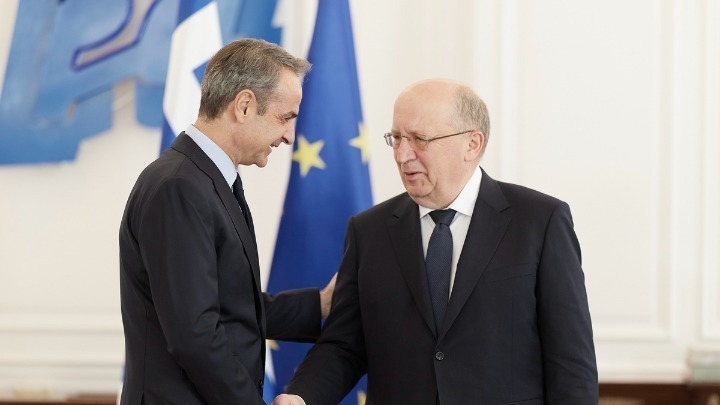
Prime Minister Kyriakos Mitsotakis on Monday received visiting European Commissioner for Defense and Space Andrius Kubilius at the Maximos Mansion in Athens. They discussed issues pertaining to the Commissioner’s portfolio, particularly the road map for strengthening the European Union’s defense readiness up to 2030 and the need to accelerate the development of Europe’s defense industry and production.
Welcoming the Commissioner, he additionally noted that the discussion was particularly important in light of the new Multi-Annual Financial Framework (MFF).
“I’m a big believer that for certain areas that we consider to be absolute priorities, we should consider joint European borrowing to support projects of common interest and I do believe that defense is the quintessential European public good and that it also needs to be supported, on top of what we do at a national level, by some sort of joint European borrowing,” the prime minister said.
Mitsotakis briefed Kubilius on the Greek program for strengthening and shielding the Hellenic Armed Forces and the emphasis given to innovation. He also repeated the necessity of giving an operational aspect to Article 42, paragraph 7 of the EU treaty.
The Greek premier noted that the European countries that had recently provided defensive support for Cyprus had acted in this direction on an ad hoc basis and without activating this article. He also called for joint European funding for programs of common European interest, such as a European air-defence shield, a proposal tabled in 2024 with Polish Prime Minister Donald Tusk.
At the start of the meeting, Mitsotakis and Kubilius had the following exchange:
Mitsotakis: I think you come at a very interesting time, when the discussion regarding Europe’s strategic autonomy and the strengthening of our defensive capabilities seems to be the number one priority of the European Council. You know that Greece has contributed significantly to this discussion. We have ‘put out money where our mouth is’ when it comes to defense spending but we have also been at the forefront of encouraging Europe to work more collaboratively in terms of defense procurement, focusing on new defense capabilities and, at a time when some of the traditional constants of the post-WWII order seem to be challenged, to put enough faith in our own European capabilities, which I always think is very important.
We are big believers in talking publicly about Article 42, par. 7 of the European treaties, we demonstrated out commitment to Cyprus when our neighbor faced an attack by Hezbollah, sending ships and airplanes, and we are very much looking forward toward operationalizing this article in terms of stronger defense commitment by European member-states should another need arise to support a member-state under attack.
And, of course, when it comes to space, we have taken our first steps, we had a launch a couple of days ago of four new microsatellites and two nanosatellites. We are beginning to establish our own footprint when it comes to space and, of course, for areas such as civil protection this is an imperative priority.
Kubilius, after thanking the prime minister for the chance to meet expressed his agreement and placed emphasis on specific points “which we consider very important”.
“First of all, we are happy to see Greece as the leader in the development of European defense, with everything that you are doing, with Achilles’ Shielf, with the 12-year plan for 26 billion euros. It is really great. I always say to other countries: ‘Look to Greece, follow what they are doing, because definitely the challenges are quite big, both for the development of our capabilities and for the development of our industry.
We need to remind ourselves always that, at the moment at least, what we see from the public figures, Russia is still outproducing us, with their war economy and the numbers are quite different. So that’s why, really, we need to speed up.
Secondly, Greece is really a very inspiring example in terms of developing your space capabilities. Congratulations for your recent launch and your participation in the very important European project GOVSATCOM (Government Satellite Communications) and for the way in which you make use of RFF funds. I try, in this case also, to tell everyone learn from Greece how to use RFF funds, to follow this good example.
The next point where obviously I agree with you absolutely – and I have said so – is that Article 42, par. 7 is very important for us, as a first step in the effort to look structurally at institutional defense readiness. In other words, that we have material defense readiness when we need to have weapons and more money for defense but then the question is institutional defense readiness and this Article 42.7 is I think really crucial.
“I did my homework, a small homework and see realistically that we have quite a lot of very good instruments. First of all, of course, on the civilian side, because if a crisis of war is coming then the civilian side as well is very important. On the military side we need to look how we can coordinate our efforts. But really, I hope that we shall be able to come out with what some sort of handbook to assist all institutions to understand what is needed to done. And the last point, definitely, is [that the] Greek presidency is coming…
Mitsotakis: Immediately after that of Lithuania
Kubilius: Exactly. So, definitely we see in defence and space are really a very important agenda. We hope that some things will be finished before that, however, defense simplification, the Space act and, most important, the next MFF, with increased defense and space spending – which we hope the governments will support – will to a great extent depend on the Greek presidency, if the issues have not finished by then.


