
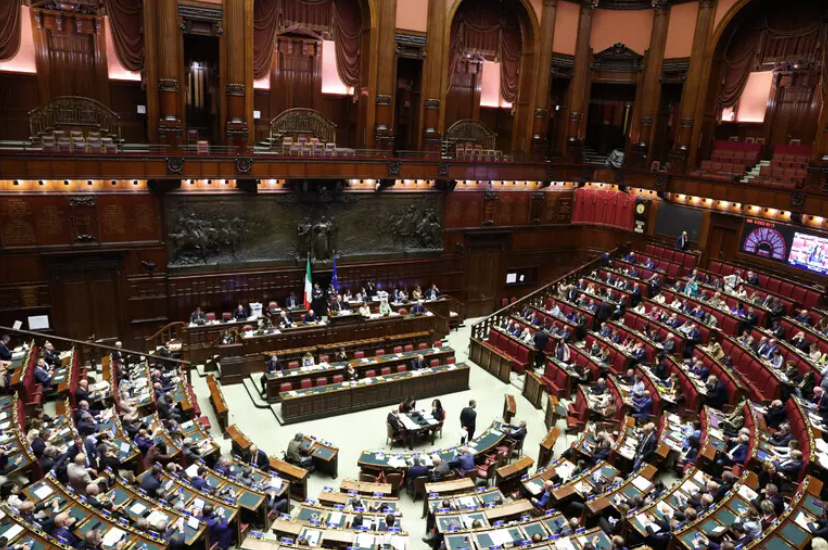
The Lower House is holding the final vote on Thursday on a bill presented by the parties of Premier Giorgia Meloni’s ruling coalition to bring in a new election law passed.
The ruling alliance say the new system will make it more likely that elections produce a clear winner.
The opposition, however, has cried foul, saying the ruling alliance is changing the system because it fears losing the general election set to take place next year and wants to minimize the chances of this happening.
Thursday’s final vote is a secret ballot and the ruling coalition suffered an embarrassing defeat in a previous secret vote on the bill during its first reading in the Lower House.
But surprises of this nature are not expected on Thursday, after the bill got the got the green light with ease in three crucial confidence votes earlier this week thanks to a show of unity from the ruling alliance.
The bill will see the current system, a mix of first-past-the-post and proportional representation, replaced with a proportional-representation system with bonus seats for the coalition that obtains the most votes, as long as it reaches a threshold of 42%, to ensure it has a working majority in parliament.
If no coalition reaches the threshold, or the votes for the Lower House and the Senate produce different results, a purely proportional system is used.
The opposition have said that, among other things, the envisioned system of bonus seats is unconstitutional and are ready to appeal to the Constitutional Court.
Coalitions will have to say who their candidate to be premier is before the election.
The bill will also give voters the option to express preferences for up to three candidates out of six on a party list in which candidates names must alternate according to gender.
The opposition says that in reality this gives “fake preferences” as the head of the ticket would always be “blocked”, arguing this was also be a step back for equality, as, in theory, it would be possible for all the ticket heads to be men.
The current system does not give voters any option to express preferences about which of the candidates on a party list they want to represent them.


