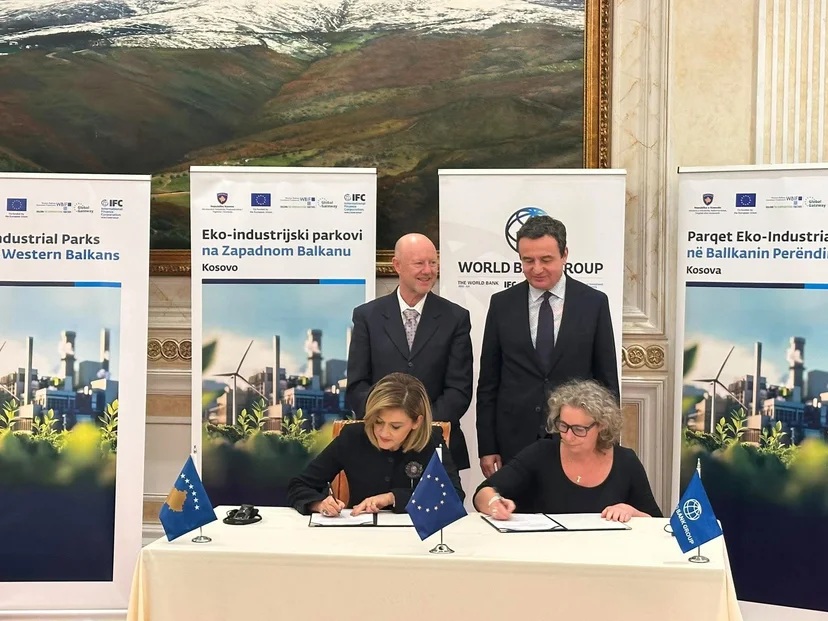
Kosovo’s Ministry of Industry, Entrepreneurship, Trade and Innovation and the World Bank have signed a cooperation agreement on the development of Eco-Industrial Parks. The project aims to expand domestic production capacities, attract investment and create new jobs, while also focusing on environmental standards.
Kosovo Prime Minister Albin Kurti said that developing industrial parks is one of the mechanisms for addressing the country’s large trade deficit. According to him, in 2025, Kosovo imported goods worth approximately €7 billion, while exports amounted to only around €1 billion.
Kurti stressed that the aim is to produce in Kosovo some of the goods that are currently imported, by creating more favorable conditions for local businesses and foreign investors. He announced that the development of industrial parks will extend to all regions of the country, including two parks in northern Kosovo.
“Despite the economic growth we have recorded, we must acknowledge that the trade deficit remains one of the main challenges facing our economy. In 2025, Kosovo imported goods worth €7 billion, while exports amounted to around €1 billion. In 2026, despite an increase in exports, the trade gap remains significant. We want as many goods as possible that we currently purchase from abroad to be produced in Kosovo. Therefore, we see industrial parks as one of the mechanisms that can help us achieve this goal. They provide local businesses with the necessary space to expand their production capacities. They create more attractive conditions for foreign investors who wish to relocate part of their production activities to our country. It is important to us that such investments bring not only capital but also new jobs, technology, knowledge and opportunities to cooperate with local suppliers… The development of industrial parks will extend to all regions of Kosovo without exception, including two parks in the northern part of our country. Following the establishment of law and order north of the Ibar River, we are gradually shifting our focus towards economic development, job creation and improving the lives of citizens living there,” he said.
Meanwhile, Minister of Industry, Entrepreneurship and Trade Mimoza Kusari-Lila said that the agreement marks a new step in cooperation towards implementing international standards for eco-industrial parks.
She stressed that the industry of the future should not be assessed solely by the volume of production, but also by how products are manufactured, the efficiency of resource use and the impact on the environment and society.
According to Kusari-Lila, a report by the International Finance Corporation (IFC) identifies the production of construction components as a sector with particular potential for Kosovo’s economy. This sector includes metal processing, the production of doors and windows, furniture, insulation materials and heating systems.
The European Union also expressed its support for the development of this concept. Head of EU Cooperation in Kosovo Hubert Perr said that the importance of industrial parks lies in the opportunities they offer for developing a more sustainable and competitive economy. According to him, this concept is also being promoted within the European Union.
Meanwhile, World Bank Country Manager for Kosovo and North Macedonia Carole Megevand said that eco-industrial parks aim to address some of the barriers faced by businesses, particularly in the management and efficient use of natural resources.
According to her, the goal is for products manufactured in Kosovo to gain greater visibility and recognition in international markets under the “Made in Kosovo” label.