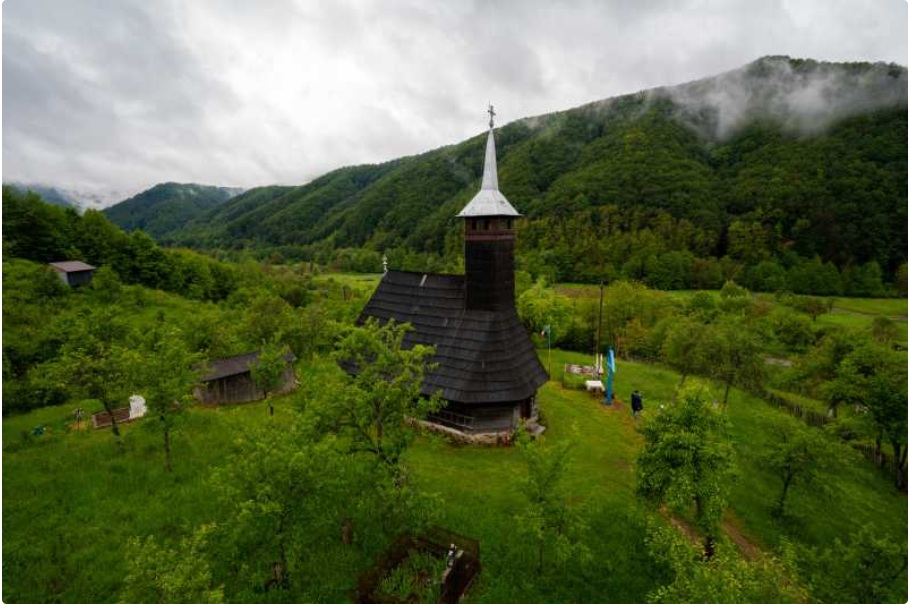
A team of specialists will carry out between May 8 – 17 a field research campaign aimed at inventorying the old wooden churches in Hunedoara County, with 29 places of worship on the Crisul Alb Valley and around the municipality of Brad to be studied as part of the project.
Among the selected objectives are both historic-monument churches, previously analysed by other specialists – for which more in-depth investigations and updates of existing information will be conducted – as well as still unresearched sanctuaries, which will benefit on this occasion from a first systematic published documentation.
“Hunedoara County has a very large number of old wooden churches. We want to reach, as a society, a perspective that allows us to know how many wooden churches we have and what their condition is, so that the competent institutions can develop future strategies that include the restoration and preservation of these important monuments,” Amalia Ignuta Acimov, one of the project coordinators, told AGERPRES.
She explained that the field teams will describe the churches they visit, assess their state of conservation, and take relevant photographs. Specialists will also speak with local residents about regional customs and about what is happening in their communities.
The project “Inventory of Romania’s Historic Wooden Churches: Churches in Hunedoara County” is carried out by the Biserici Înlemnite Association, in partnership with the National Heritage Institute (INP), the Dacian and Roman Civilization Museum in Deva, the Romanian Peasant Museum, the Hunedoara County Directorate for Culture, and the Faculty of Arts and Design of Timisoara’s West University.
The project is supported by the Diocese of Deva and Hunedoara and is financed by the Romanian Order of Architects through the Architecture Stamp Duty.
The working group includes nearly 20 professionals, students and volunteers, specialized in several investigative and research directions – from architectural and landscape analysis, craftsmanship and wood-processing expertise, to photographic documentation and 3D scanning.
The team includes architects, restorers, art historians, anthropologists, ethnographers and digitisation specialists, as well as experts certified by the Ministry of Culture in the conservation and protection of historic monuments.
The research results will be available free of charge shortly after the campaign concludes, on the platform https://biserici-inlemnite.ro/ro/app, both in a synthesised form for the general public and in an extended format available on request to specialists and interested parties.
This is the fifth field research campaign organized by the Biserici Înlemnite Association together with its partners and collaborators, after those in the counties of Arad, Iasi, Gorj and Hunedoara – Mures Valley, with 136 old churches inventoried so far.