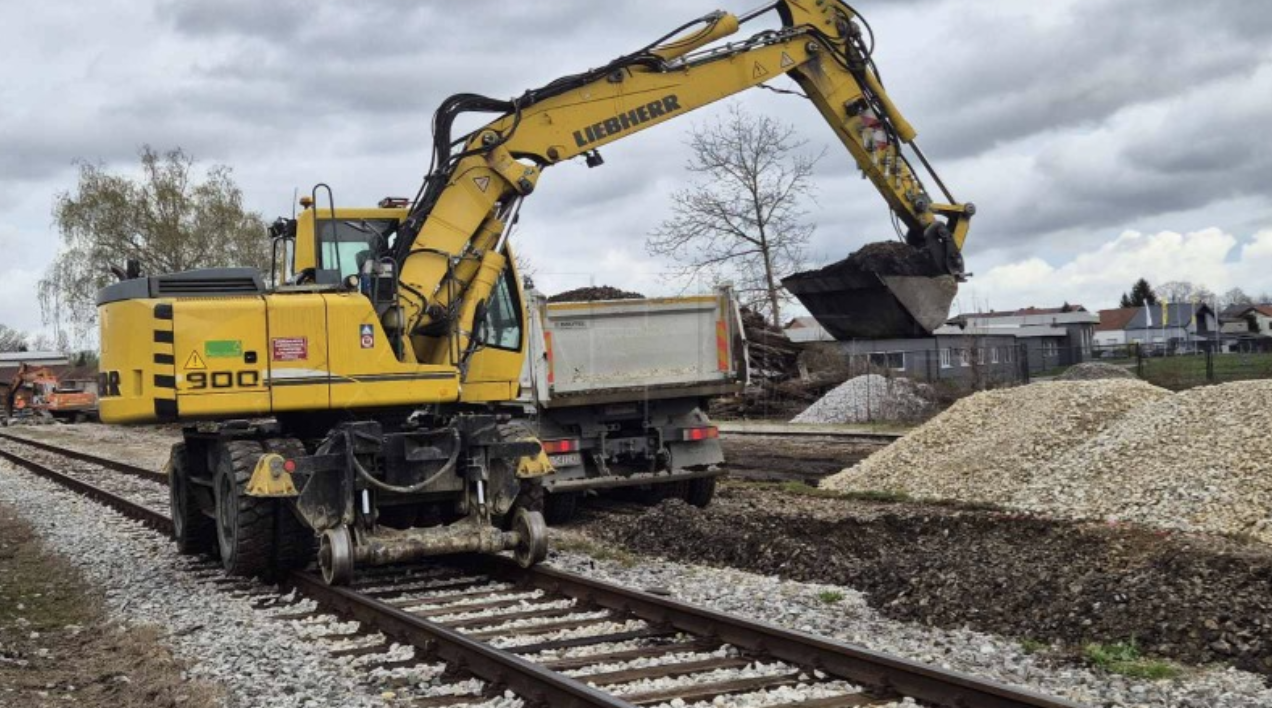
Speed restrictions are currently in place on 237 kilometres of railway lines in Croatia, and the government plans to invest a further 6 billion euro in rail renewal and modernisation by 2035 to increase speeds and capacity, HĹ˝ Infrastruktura and the Ministry of Maritime Affairs, Transport and Infrastructure said.
Croatia has 2,617 kilometres of railway lines, of which 166 kilometres are out of service. Around 400 kilometres are double-tracked, including Dugo Selo-KriĹľevci and KriĹľevci-Koprivnica-state border, where projects are nearing completion.
HĹ˝ Infrastruktura said most speed restrictions are due to infrastructure conditions and ongoing renewal, modernisation and maintenance. Currently, 237 kilometres are affected by such restrictions. The routes generating the most passenger-train delay minutes in 2025 and 2026 included Zagreb-Koprivnica-Zagreb, Zagreb-Osijek-Zagreb and Zagreb-Split-Zagreb.
Modernisation is expected to enable speeds of up to 160 km/h on international lines, 120 km/h on regional lines and 80 km/h on local routes. Double-tracking will also eliminate delays caused by trains waiting to pass on single-track lines, while the aims of the project include improving punctuality, safety and capacity.
€6bn planned by 2035
The Transport Ministry said railway investment was currently at its highest level since Croatia became independent. More than €2bn has been invested over the past decade, with 2025 investment almost five times higher than in 2017. A further €6bn is planned by 2035.
Key projects include reconstruction and double-tracking on the KriĹľevci-Koprivnica-state border, Dugo Selo-KriĹľevci and Hrvatski Leskovac-Karlovac sections. A contract worth almost €700 million is expected for Dugo Selo-Novska, potentially Croatia’s single largest railway project.
Work on Dugo Selo-KriĹľevci is 99% complete and is expected to finish by the end of this year. The project faced lengthy delays, partly due to contractors’ financial difficulties.
The KriĹľevci-Koprivnica-state border project is also nearing completion. Construction should finish by the end of the year, followed by testing of traffic management and signalling systems, inspections and operating permits. A gradual increase towards the designed maximum of 160 km/h is expected with the 2026/27 timetable.
HĹ˝ Infrastruktura attributed delays partly to the COVID-19 pandemic, the war in Ukraine, difficulties procuring materials and landslides towards the Hungarian border. Much of the work is also being carried out while passenger and freight services continue.
Lowland railway and route to Rijeka
Future investment will focus heavily on connecting Rijeka, Zagreb and the Hungarian border. Designs are being prepared for the future lowland railway sections Karlovac-Skradnik and Skradnik-Krasica-Tijani, with location-permit applications expected by the end of 2026. Costs, funding and construction dates have yet to be determined.
Preparatory work is under way on Hrvatski Leskovac-Karlovac, including reconstruction of 44 kilometres of track, construction of a second track, electrification, signalling and telecommunications works, and reconstruction of three stations. Completion is scheduled for 2029.
Modernisation will also cover regional and local routes including Knin-Zadar, Čakovec-Varaždin-Koprivnica-Kloštar, Pitomača-Kloštar, Banova Jaruga-Daruvar, Osijek-Koška and lines in Istria.
Planned investment for 2026-2028 totals €1.4bn, including €232m for regional and €84m for local lines.
The ministry cited lengthy project preparation, a shortage of engineers, property issues, permitting, spatial-plan changes and complex procurement and appeals as key obstacles. Carrying out works while rail services continue also affects construction schedules.
The ministry expects the major projects to be completed by 2035, significantly reshaping Croatia’s railway network and improving speeds, punctuality, safety and capacity.