
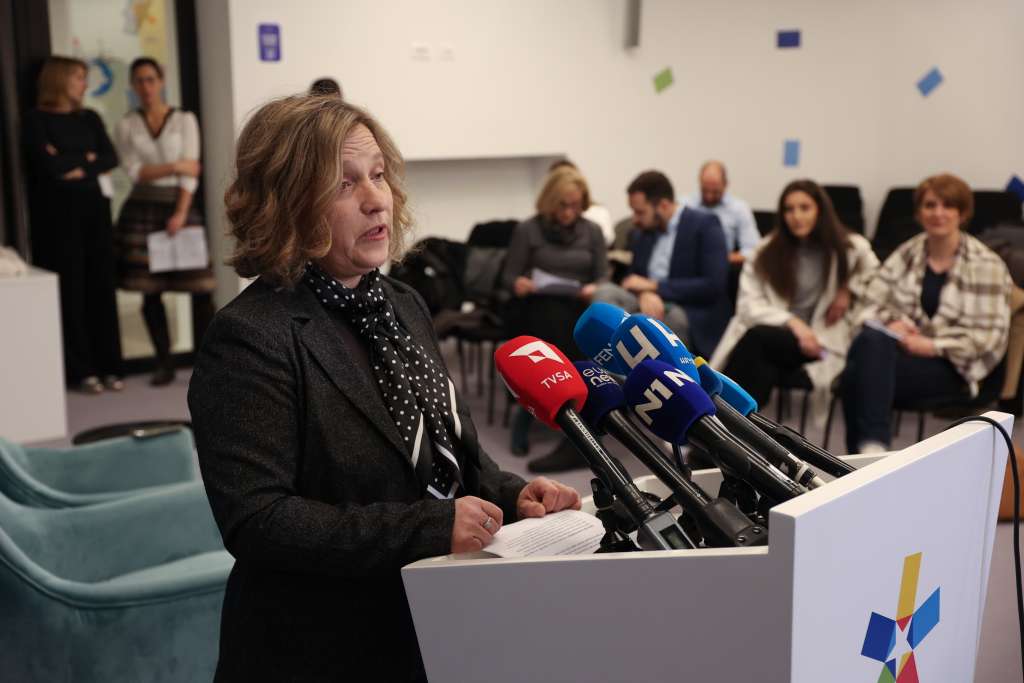
SARAJEVO, November 10 (FENA) – Bosnia and Herzegovina has made no significant progress in any of the 19 areas of European integration analyzed over the past year, while regression was recorded in 10 areas, limited progress in seven, and no change in two, it was said today at the presentation of the Alternative Report on BiH’s progress toward European Union membership for 2025/2026.
The report, titled “BiH’s European Path: A Year of Lost Opportunities,” was prepared by the Initiative for Monitoring European Integration in BiH. It examines the situation in the areas of the rule of law, the fight against corruption, the functioning of institutions, human rights and media freedom.
Dragana Dardić, a representative of the Initiative, said that 11 civil society organizations had participated in preparing the report, analyzing areas covered by the first cluster of EU accession negotiations, which concerns the fundamentals.
“Unfortunately, this report also leaves little room for optimism. No significant progress has been recorded in any of the areas it covers,” Dardić said.
Regarding human rights protection, she noted that amendments defining femicide as a separate criminal offense had been adopted in the Federation of BiH, but that this had not prevented further killings of women.
According to media reports, at least 10 women were killed in BiH between mid-2025 and August 2026, mostly with firearms, while a unified femicide database has yet to be established.
Dardić also warned of the lack of progress in the legal recognition of same-sex partnerships and inconsistent protection of children’s rights, particularly regarding the collection of child support payments.
Edo Kanlić, a representative of Transparency International BiH, said the European integration process had effectively ground to a halt due to the failure of key institutional mechanisms to function.
“Over the past year, the process has been practically dead, because none of the structures necessary for the effective management of European integration has functioned adequately,” Kanlić said.
He stressed that BiH still has no integration program, chief negotiator or IPA coordinator, while the structures needed to implement the European Union’s Growth Plan have also not been established.
According to him, BiH is the only Western Balkan country that has not yet formally joined the Growth Plan, as it has neither signed nor ratified the agreements on the Facility and the Loan, putting access to approximately one billion euros in available funds at risk.
He warned that if progress in implementing reforms is not made by the end of the year, BiH could permanently lose access to 373 million KM in funding.
Kanlić also pointed to serious shortcomings in the system for preventing conflicts of interest, noting that the state-level law adopted in 2024 is still not being properly implemented because the relevant bylaws have not been adopted, while the Federation of BiH has had no body responsible for its implementation since 2013.
Lejla Bičakčić, director of the Center for Investigative Reporting, warned that judicial reforms had stalled, particularly due to the failure to adopt laws on the High Judicial and Prosecutorial Council and the Court of BiH, which remain key outstanding conditions for advancing the European path.
According to her, none of the proposed legislative texts is aligned with the recommendations of the Venice Commission, and there is a lack of political will to reach an agreement.
She particularly highlighted the record in prosecuting high-level corruption, noting that only six indictments were filed in 2025, a decline of nearly 75 percent compared with previous years.
“About 50 percent of those convicted of corruption receive suspended sentences, while more than 54 percent of resolved reports of corruption-related criminal offenses are closed without an investigation being launched,” Bičakčić said.
She added that only around 22 percent of asset declarations submitted by judges and prosecutors had been reviewed, a shortcoming that had also hindered appointments to judicial positions in the past period.
Maida Čulahović, a representative of the organization Zašto ne, said regression had been recorded in the area of freedom of expression, particularly regarding media ownership transparency, regulation of the online space and the independence of the Communications Regulatory Agency.
She noted that BiH still has no legislation ensuring transparency of media ownership, while no concrete steps have been taken to align domestic regulations with the European Digital Services Act.
As an example of potentially restrictive regulation of the online space, she cited a decision by the Municipality of Kakanj defining certain forms of expression on social media as misdemeanors, resulting in the issuance of 11 misdemeanor notices.
Čulahović also warned that the draft Law on Electronic Communications contains provisions that could further undermine the political and financial independence of the Communications Regulatory Agency.
Aurelie Valtat, Head of the European Integration, Political and Economic Affairs Section of the EU Delegation to BiH, said this year’s European Commission report confirmed that, despite the authorities’ declared commitment to EU membership, Bosnia and Herzegovina continues to fall behind on its European path.
She noted that some progress had been made in combating organized crime, protecting intellectual property and in the customs sector, but serious problems remained in the judiciary, the fight against corruption and freedom of expression.
“Bosnia and Herzegovina remains the only country in the region that has not yet used a single euro allocated under the Growth Plan,” Valtat said, emphasizing that the consequences of the lack of reforms are directly felt by citizens through insufficient investment in education, healthcare, infrastructure and digitalization.
She also pointed to opportunities for gradual integration into the EU before full membership, including access to the Single Euro Payments Area (SEPA), more favorable roaming conditions and expanded cooperation with European agencies.
Valtat welcomed the contribution of civil society organizations to the preparation of the Alternative Report, saying its findings would be carefully considered in Brussels.
Conference participants said political and institutional blockages were among the main reasons for the stagnation of European integration and stressed the urgent need to establish functional negotiating structures, ensure the implementation of reforms and protect citizens’ rights.
The Alternative Report also contains eight key recommendations aimed at unblocking Bosnia and Herzegovina’s European path.


