
Tassoulas: Reunification of Parthenon Sculptures would be a gesture of great significance
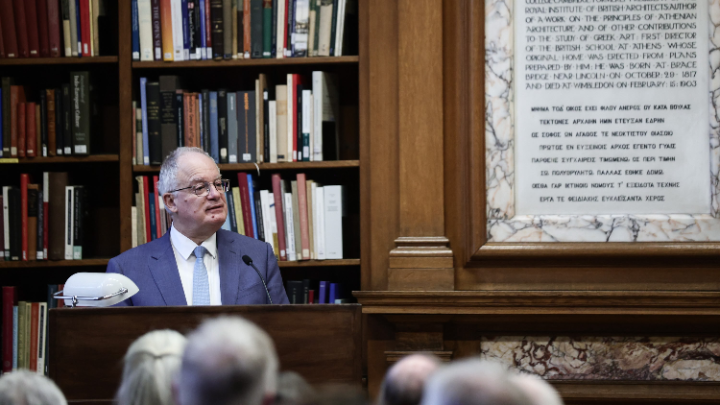
President of the Hellenic Republic Constantine Tassoulas stressed the importance of reunifying the Parthenon Sculptures during an address at the British School at Athens on Friday evening.
“The reunification of the Parthenon Sculptures would be a gesture of enormous significance,” Tassoulas said, emphasising that “if we accept that the Parthenon is a beacon of the European spirit and Western thought, we cannot accept that it should remain indefinitely without its Sculptures.”
He also urged the audience to reflect on “the greatness of the actual reunification of the Parthenon Sculptures, which would follow the greatness of such a gesture.”
Speaking about the contribution of foreign archaeological schools to promoting ancient Greek civilisation, Tassoulas referred to their significant role in reconstructing the memory of Greece and Europe, as well as in establishing the classical heritage as a universal ideal and the foundation of a European identity.
He observed, however, that their establishment was motivated not only by Europe’s need to seek its roots in classical antiquity, but also by the scientific ambition to develop archaeology as a discipline based on methodology, documentation and international cooperation.
He recalled that in the 19th century, archaeology was often associated with collecting, extracting and appropriating antiquities. In the 20th and 21st centuries, however, foreign archaeological schools, working alongside the Greek Archaeological Service, which had established standards early on that are now taken for granted, helped bring about a shift towards a new approach, according to which “ finds belong to their place of origin, research must be conducted transparently and its findings shared, while documentation is an act of responsibility.”
“Following the Second World War, the number of foreign archaeological schools grew, reaching 19 today and serving as repositories of knowledge and experience,” he noted.
He added that “they constitute an institution that began with philhellenism, matured through science and today functions as a global community of memory and knowledge.”
Tassoulas observed that “foreign archaeological schools have made a decisive contribution to revitalising our identity and culture – and continue to do so. Consequently, we now have all the materials needed to build the future. For the seeds of the future lie in the memory of yesterday.”
He concluded by describing the schools as “bridges between Greek antiquity and the international scientific community, which will, over time, influence the ethics of science.”


