
Symposium of the “International Community of Academies”: Climate crisis, protection of cultural heritage and resilience of societies
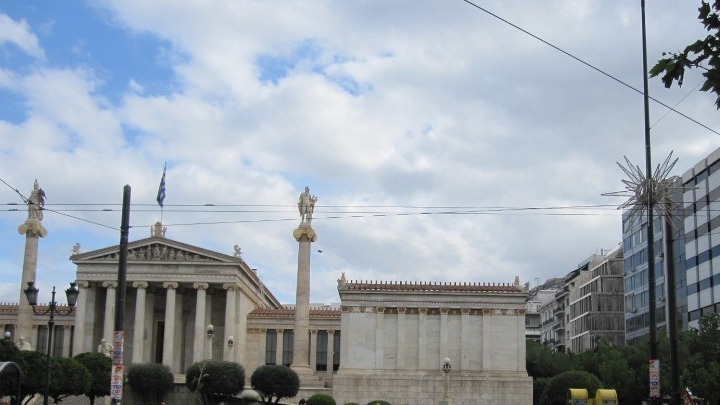
The climate crisis, the protection of cultural heritage, the resilience of societies and natural disasters dominated the second day of the Symposium of the “International Community (Koinon) of Academies”, a new organisation of the Academy of Athens.
In a special section focused on climate change in the Anthropocene era and the resilience of cultural heritage in the Mediterranean, the President of the Board of the “International Community of Academies” Christos Zerefos referred to the study on the climate crisis and the efforts to monitor its impacts on the monuments of the Mediterranean that belong to the UNESCO world heritage list.
As Zerefos said, the study presents the vulnerability of UNESCO cultural and natural heritage monuments in the Mediterranean, using six climate indicators and a seismic indicator. The climate indicators represent extreme heat, fire risk, extreme rainfall (floods, landslides), drought, frost damage and sea level rise, while seismic risk is expressed through maximum ground acceleration.
“All climate-related risks are projected to increase in the future, with significantly stronger impacts in the RCP8.5 scenario without mitigation measures. The cumulative effect of climate and seismic risks is assessed through an integrated risk index, which identifies monuments exposed to multiple interacting risks. In the worst-case scenario, 35 monuments fall into the ‘high risk’ category and 12 into the ‘extreme risk’ category, especially in the coastal and eastern Mediterranean regions,” Zerefos said.
On his part, Petteri Taalas, Professor and Director General of the Finnish Meteorological Institute, Member of the Finnish Academy of Sciences and Letters and Honorary Secretary General of the World Meteorological Organisation, presented in detail the state of the global climate as well as the prospects for mitigating climate change. As he said, the rise in global temperature exceeded 1.5 ° C during the period 2023-25, while records have been broken for the concentrations of carbon dioxide, methane and nitrous oxide. At the same time, he emphasised that an increase in heat waves has been observed all over the world, in half of the planet an increase in floods while in one third an increase in droughts. He added that sea ice cover in the Arctic and Antarctic is shrinking, while in 2025 new record lows were recorded in the thickness of Arctic sea ice.
“The rate of melting of glaciers has accelerated and can no longer be stopped. Therefore, the rise in sea levels will continue for centuries to come. The Mediterranean region will suffer higher temperatures and less rainfall, which will threaten agriculture and tourism,” he noted.


