
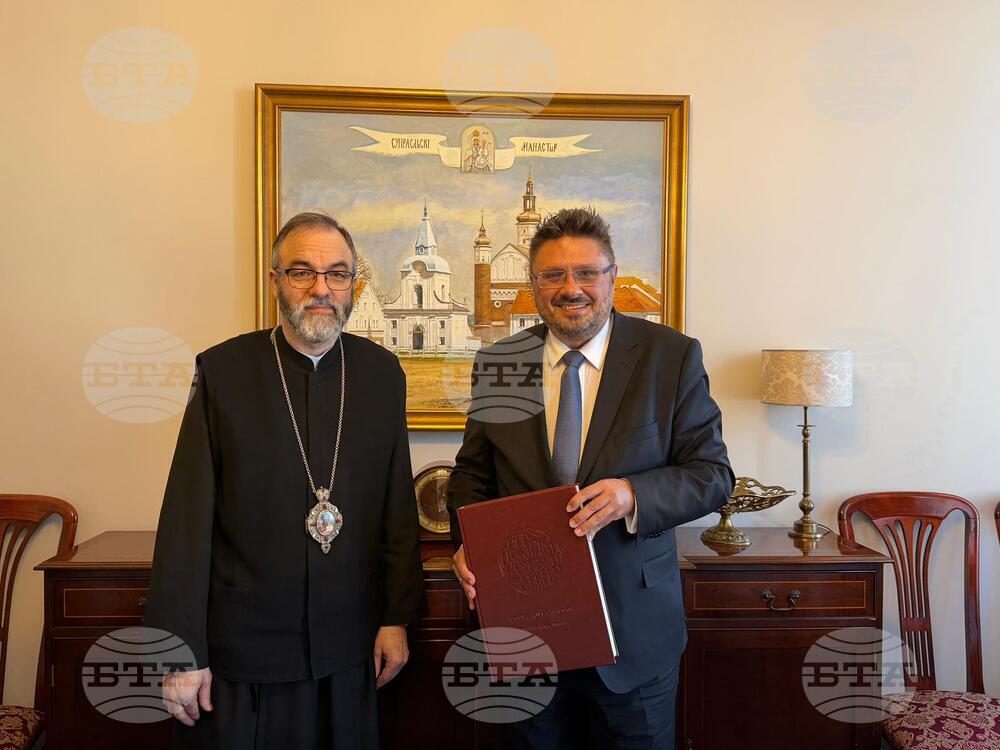
The library of the Orthodox Suprasl Monastery in Poland and the academy affiliated with it will receive the magazine LIK and other publications of the Bulgarian News Agency (BTA). The commitment was made Saturday by BTA Director General Kiril Valchev during a meeting with the monastery’s abbot, Bishop Andrzej, and prominent Polish Bulgarist Prof. Aleksander Naumow, who oversees the library.
Also attending the meeting were Bulgaria’s Ambassador to Poland Margarita Ganeva and Bulgaria’s Honorary Consul in Bialystok Witold Karczewski. In Bialystok, were the monastery is located, the three also met with the Orthodox Archbishop of Bialystok and Gdansk, Jakub, who noted that many of Poland’s Orthodox Christians live in the area. The Orthodox community in Poland numbers about 600,000 people.
“By distributing BTA publications to places where the memory of Bulgaria is preserved, where Bulgarian studies are developing, and where Bulgarian communities live, BTA fulfills in yet another way its legal obligation to promote and protect the Bulgarian literary language, national traditions and culture,” Valchev said. He also discussed the possibility of publishing an issue of LIK in Polish.
The Suprasl Monastery, located about 200 km northeast of the Polish capital Warsaw, has preserved since the 16th century the Codex Suprasliensis, which was discovered by scholars two centuries ago. It is the most extensive and one of the earliest surviving Old Bulgarian manuscripts from the Preslav Literary School during the Golden Age of Bulgarian culture in the 10th century.
The codex is also known as the Codex of Retko, after the copyist Retko, who wrote a large part of it and left his name in a note. It contains saints’ lives and festive sermons for the month of March and represents the oldest known menaion for March in Slavic and Byzantine literature.
The manuscript is now divided into three parts kept in Warsaw (Poland), Ljubljana (Slovenia) and St. Petersburg (Russia). It was split when it was discovered in 1823 by Belarusian scholar Mikhail Bobrovsky, who sent part of the manuscript to scholar Jernej Kopitar, leaving 118 folios in the University Library in Ljubljana. Another section, consisting of two gatherings with a total of 16 folios, was purchased in 1856 by Afanasii Bychkov, then head of the Imperial Public Library in St. Petersburg.
Valchev is visiting Poland for meetings with representatives of the Bulgarian community, to whom he presented on Friday the work of Bulgaria’s national news agency and the opportunities for expanding the presence of news from Bulgarians abroad in BTA’s coverage.
On Friday morning, Valchev met with Tomasz Makowski, Director of the National Library in Warsaw. The BTA Director General presented the English editions of LIK magazine and a book compiling news from BTA archives spanning its history from 1898 to the present, and committed that the agency will send all issues of the magazine annually to the Polish National Library. Valchev also examined preserved parts of one of the largest and earliest Old Bulgarian manuscripts from the Preslav Literary School of the Golden Age of Bulgarian culture in the 10th century – the Codex Suprasliensis.
Later on Friday, Valchev and Ambassador Ganeva also attended the unveiling of a monument to Bulgaria’s national hero, the “Apostle of Freedom” Vasil Levski, in the courtyard of the Bulgarian Embassy in Warsaw. The monument was created by sculptor Stanislav Korchev and architect Tzeno Todorov. “BTA has begun regularly publishing news about the Bulgarian community in Poland in the newly established ‘BG World’ section. To date, it contains a total of 337 reports on Bulgarians in Poland,” the BTA Director General told the Bulgarians in Warsaw. He emphasized that, according to the official 2021 census, there are 2,373 Bulgarians in Poland, but unofficial estimates put the number at 15,000, indicating a wider scope for news coverage.
As important sources of information about the Bulgarian presence in Poland, Valchev highlighted the highly active embassy and the Bulgarian Cultural Institute in Warsaw, the five honorary consuls of Bulgaria in Poland, the Dora Gabe Bulgarian School in Warsaw with a branch in Krakow, Bulgarian associations in Warsaw and Krakow, as well as lecturers and students of the Bulgarian language at Polish universities and of Polish at Bulgarian higher education institutions.
According to the official census in 2021, there are 2,373 Bulgarians in Poland, although the number is likely higher, judging by the Bulgarians in Poland Facebook group, which has more than 3,200 members. According to unofficial estimates cited by Ambassador Ganeva, the Bulgarian community in Poland may reach 15,000 people.


