
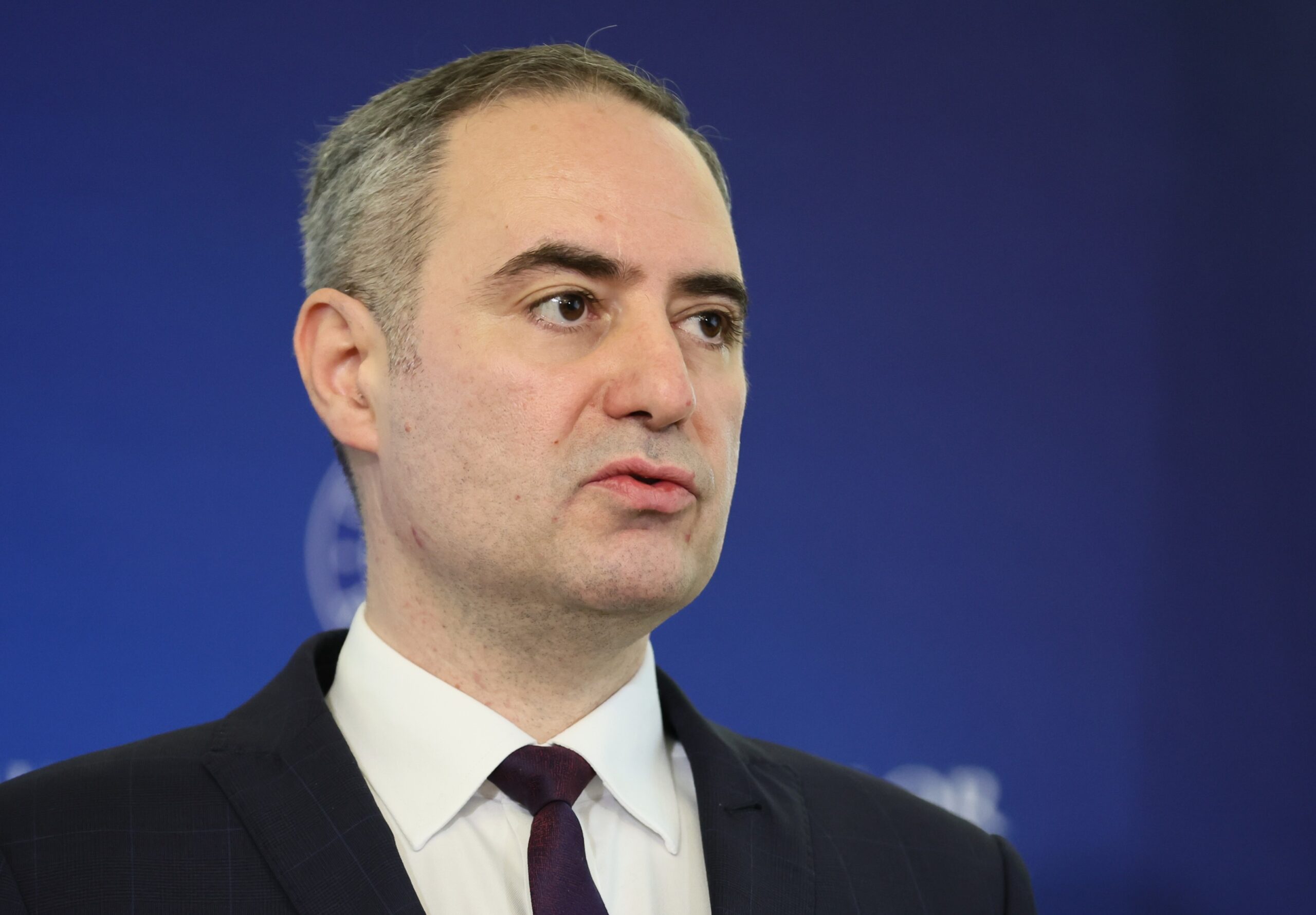
Romania on Wednesday, alongside eight other countries, defended its bid to host the future EU Customs Authority during a question and answer session of the European Parliament’s Internal Market and Consumer Protection Committee (IMCO), with Finance Minister Alexandru Nazare insisting on the country’s strengths in cyber security expertise, the competitiveness of the labour market in Bucharest and the immediate availability of the future headquarters.
In his opening remarks, Finance Minister Alexandru Nazare said that Romania is applying to host the headquarters of the new EU Customs Authority (EUCA) for a simple reason: ‘We believe in European customs reform and we want it to succeed.’
‘One of the first measures of my government was the introduction of a customs duty on small parcels from outside the EU. We understood the risk posed by uncontrolled trade,’ Nazare explained to MEPs in the European Parliament’s IMCO committee.
‘Why are we suitable? Our entire offer is built on speed and capacity. We already have a prepared headquarters, we have the necessary technical infrastructure and we have the political will to remove obstacles. Romania is committed to making customs reform work, not just to providing a headquarters for the EU customs authority,’ the Romanian minister assured.
‘Our system has shown resilience and the capacity to adapt, even in the most difficult environments,’ he added.
Nazare also said that Bucharest is recommended by its connectivity and solid base of experts, as well as by the presence in the capital of the European Cybersecurity Centre.
Last but not least, Nazare said that Bucharest is a European capital offering all the necessary infrastructure and a place where Agency staff will enjoy a high standard of living. ‘Choose Bucharest, choose Romania,’ Nazare told the MEPs.
In total, nine cities are bidding to host the future EU Customs Authority: Bucharest, Liege in Belgium, Lille in France, Malaga in Spain, Porto in Portugal, Rome in Italy, The Hague in the Netherlands, Warsaw in Poland and Zagreb in Croatia.
Bucharest’s bid was supported in an initial question and answer session of the IMCO Committee alongside those of Liege, Lille and Malaga.
The bid of the city of Lille attracted the interest of the highest number of MEPs in the IMCO Committee, namely nine, while that of Malaga was addressed five questions.
Romania’s bid attracted the interest of three MEPs, namely Adina Valean and Maria Grapini from Romania, and Dirk Gotink, a Dutch MEP from the EPP group.
PNL MEP Adina Valean said in her intervention that an agency as large as the new customs authority will need to attract employees from the local labour market as well. She pointed out that if a place or a country hosts many European agencies, its attractiveness is limited. The former European Commissioner for Transport asked the Romanian finance minister what he considers to be the added value of the city of Bucharest for this agency in terms of the labour market and the relationship with the national administration.
Alexandru Nazare underlined that many companies in the information and communications technology sector have invested heavily in service centres in Bucharest. He also pointed out that Romania has very good specialists in the digital area.
‘We have demonstrated that we are the capital of cyber security because we have the Cybersecurity Centre in Bucharest. We were able to demonstrate this everywhere when dealing with cyber security and the digital area. And I believe this is an essential advantage because we are talking about a hub, a customs data centre that this agency will operate and we need to secure this data hub,’ he said.
Dirk Gotink from the EPP group asked Romania’s representative how he can guarantee that what is already available in terms of cyber security in the country is sufficient, in the context of the war in Ukraine and other possible future developments, to ensure the protection of the future customs authority.
‘In terms of cyber security, Romania has proven itself not only now but even before the outbreak of the war in Ukraine, because it received several protection missions in that context. We have demonstrated our competitive advantage in the area of cyber security. This is because we had staff available, we had talent and we had resources from several areas,’ the minister explained.
He said that a few years ago no one believed that Romania should host a European Cybersecurity Centre, but that now ‘we are the best.’ ‘Bucharest is a true ecosystem when it comes to cyber security,’ he assured.
Social Democratic Party (PSD) MEP Maria Grapini asked whether, if Bucharest’s bid is accepted, the required number of employees could be covered.
‘Rent is covered by Romania for 15 years in a building of over 9,000 square metres, with possibilities for expansion. All fit-out costs will be covered and the building is immediately available. We will also cover the costs of possible expansions and we also have tax incentives for EUCA staff,’ the minister told the IMCO Committee MEPs.
He assured them that Bucharest offers many advantages in terms of employment opportunities.
‘So it is not just about a building secured against cyber attacks, it is not just about a safe neighbourhood, Bucharest is a safe city, you can walk around both day and night in complete safety, which is an extraordinary advantage nowadays,’ the finance minister added.
The European Parliament will make a decision in the coming weeks, followed by a final European Parliament – Council decision. AGERPRES (RO – writing by: Florin Stefan; EN- writing by: Adina Panaitescu)


