
Fully renovated and with new uses, the Old Acropolis Museum – the “Mouseion”, as inscribed above the building’s entrance since its foundation – has reopened after nearly two decades.
Both the Old Acropolis Museum and the completed landscaping and enhancement works of the Eastern Plateau of the Sacred Rock were inaugurated on Monday by Prime Minister Kyriakos Mitsotakis.
The works were presented in an atmosphere of “emotion” and “high symbolism” to journalists by Culture Minister Lina Mendoni and the Head of the Ephorate of Antiquities of the City of Athens, Elena Kountouri. Also participating in the presentation were Dimitris Daskalopoulos, founder of the non-profit cultural organisation NEON, internationally acclaimed artist Michael Rakowitz, and Panagiotis Parthenios, professor at the School of Architecture of the Technical University of Crete.
“The ‘Mouseion’,” Mendoni said, “had to continue protecting antiquities, while also pioneering.
“To continue fulfilling its role as a centre for showcasing the arts, philosophy, theatre, and sciences born in ancient Athens.
“To project the dynamism of contemporary art, nourished by the heritage that Greece offered to the world, and to utilise modern scientific knowledge and innovation to disseminate the principles and values of an inherently anthropocentric civilisation, as encapsulated in the monuments of the Acropolis, and particularly the Parthenon.”
Under its new operation, the museum combines temporary exhibition activity with the organised safekeeping, protection, and showcasing of antiquities.
As part of the works, storage areas and the conservation laboratory were upgraded, while appropriate infrastructure was created for the safe storage and permanent display of architectural members, sculptures, and inscribed stones, many of which were scattered across the archaeological site or temporarily stored in areas inaccessible to the public.
The new museological approach organically links safekeeping and conservation with the exhibition experience.
Specially designed metal structures house architectural members, inscriptions, and sculptures, while movable chain curtains allow for the selective highlighting of antiquities through lighting and digital projections. In this way, the storage spaces are discreetly integrated into the exhibition experience, highlighting the wealth of the broader archaeological ensemble.
The museum’s first temporary archaeological exhibition, titled “ATHINAI POLIS IDEA”, presents more than 750 archaeological artefacts, most of which are being displayed to the general public for the first time. Through finds from the Ephorate of Antiquities of the City of Athens, it spans a long historical trajectory from the Neolithic era to its great heyday and its timeless resonance.
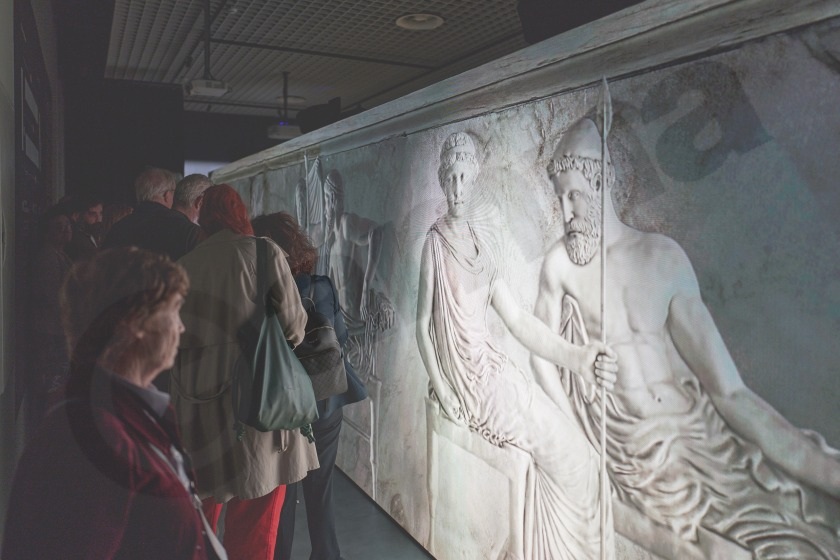
In cooperation with the Technical University of Crete, “Parthenon Alive” was developed – an innovative, scientifically documented digital cultural experience at the Old Acropolis Museum that combines historical and archaeological documentation with artificial intelligence, 3D reconstruction, immersive technologies, and multimodal storytelling.
At its core are the Parthenon frieze depicting the Panathenaic procession, in which religious worship is interwoven with public life and the collective identity of the Athenian city, and the Acropolis through its successive transformations over the centuries from prehistoric to modern times.
Rounding out the museum’s exhibition programme is a contemporary art exhibition by artist Michael Rakowitz. This is the first contemporary art exhibition held on the rock of the Acropolis and marks a major milestone in the long-standing collaboration between the NEON organisation and the Culture Ministry.


