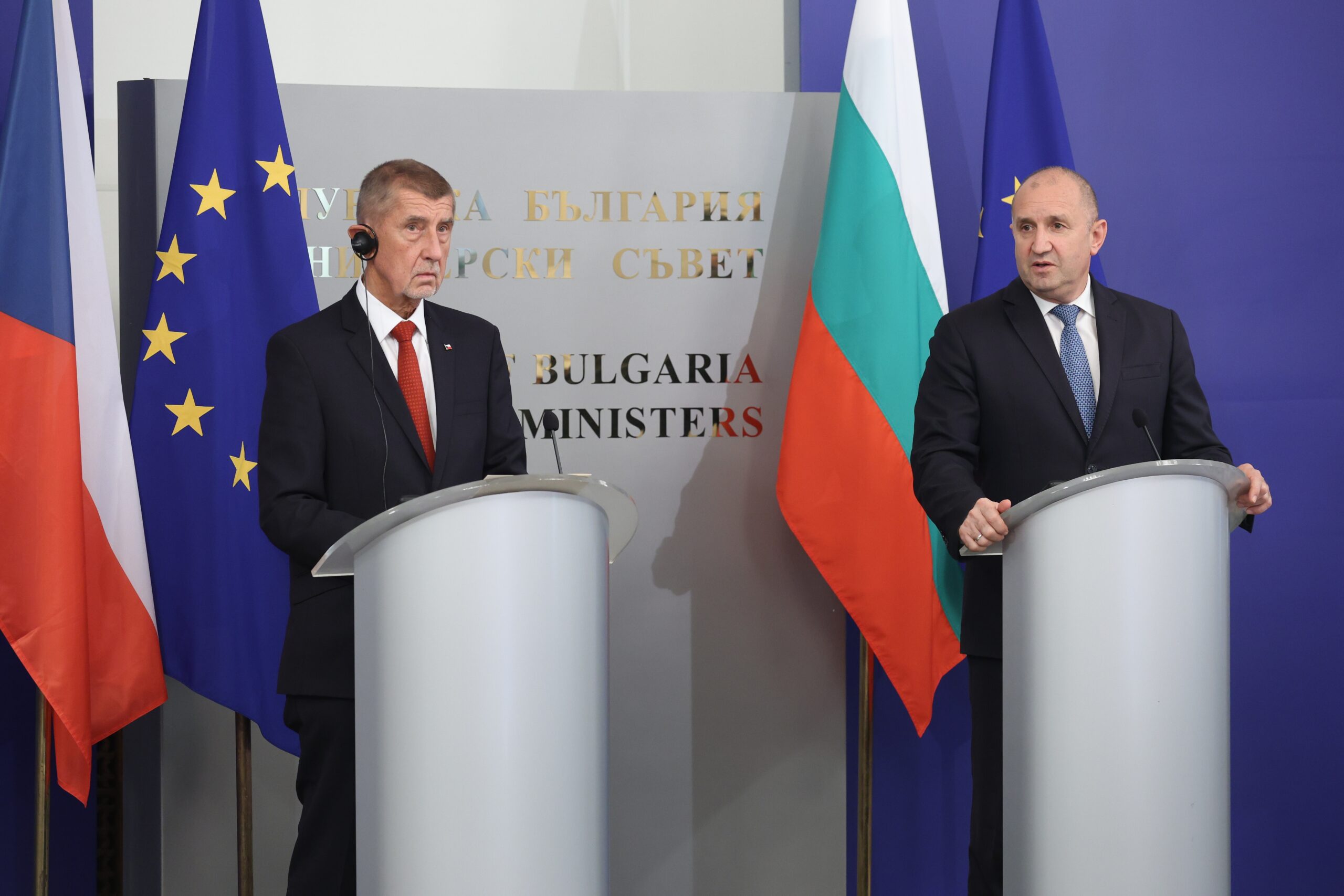
Bulgarian Prime Minister Rumen Radev and his Czech counterpart Andrej Babis held a one-on-one meeting here on Wednesday as part of Babis’ official visit to Sofia. At a joint news conference after the meeting, Radev said Bulgaria and Czechia discussed potential cooperation on the development of nuclear projects. “We agreed to establish a joint working group to foster mutually beneficial cooperation in this area, which is of paramount importance for the future of our energy systems and industries,” said Radev.
He also said that the two countries share the conviction that the energy sector is the foundation of their economic development, and therefore support all efforts to ensure that nuclear energy finds its place on an equal footing with other green renewable energy sources. Radev commended Czechia for taking the first important steps toward projects involving small modular reactors. In his words, Prime Minister Babis is one of the strongest advocates for ensuring that Europe has affordable, reliable, and stable electricity. Radev added that the two share the common belief that the European emissions trading system must be revised, and that ETS 2 should be postponed and revised immediately, because Europe’s industrial security and independence must be guaranteed.
He said further that Bulgaria is ready to support Czechia and the countries of Central and Eastern Europe in their efforts to diversify and ensure the stability of energy supplies. “We have unrestricted access, under clear agreements, to the two Greek terminals and the five Turkish terminals for liquefied natural gas, and we can, at any time, through reserved capacities, help our partners and friends ensure reliable natural gas supplies – and this is just the beginning,” the Bulgarian Prime Minister stated. He added that, looking ahead, this also applies to the green energy corridors that are set to pass through Bulgaria from North Africa and the Caucasus region.
Radev highlighted the growing presence of the Skoda Group in Bulgaria and outlined the prospects for new joint projects in the fields of transport, industrial cooperation, and high technology. According to Radev, Bulgaria and Czechia have a strong energy mix and should take advantage of the industries of the future, such as data centers and artificial intelligence factories. Bulgaria has much to offer in this regard, as the Institute for Computer Science, Artificial Intelligence and Technology (INSAIT) in Sofia is already developing its own artificial intelligence models, Rumen Radev added.
In the defence industry, the two countries are among Europe’s leaders in ammunition production, are working together on the production of drones and anti-drone systems, and are set to deepen this cooperation, Radev said.
Strong historical and cultural ties are reflected in a steadily growing trade volume of EUR 3 billion and increasing Czech investment in Bulgaria, Radev went on to say. “We are looking ahead not only to trade but also to joint projects for technology development, research, and manufacturing, so that together we can enter the markets of third countries,” said the Bulgarian Prime Minister.
The Czech Prime Minister said that his country and Bulgaria share the same views on the energy sector, and that is important. He recalled that years ago, he insisted that nuclear energy be included in the EU’s conclusions and noted that attitudes toward it in Europe are now changing. In his view, nuclear energy should be placed on an equal footing with renewable energy sources.
He noted that there are two wars, which are unacceptable and everything is being done to bring them to an end. In his words, these wars have a strong impact on Europe and are destroying the energy sector.
Babis said he had invited the Bulgarian Prime Minister to Czechia. Future contacts between the two countries are eagerly anticipated, he added.