
Mitsotakis: Greece to send first astronaut within two years; 350-million-euro space plan
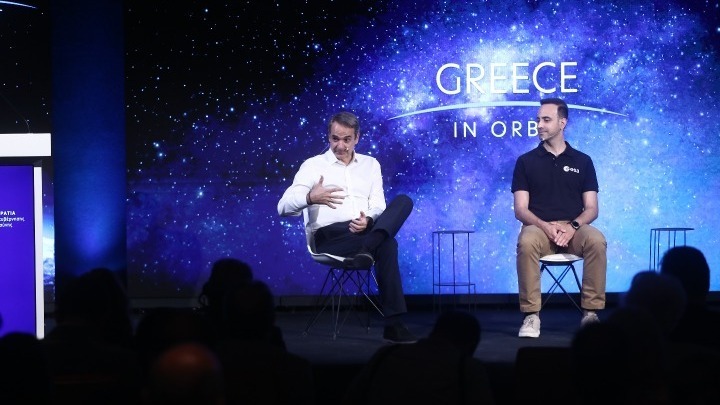
Prime Minister Kyriakos Mitsotakis, in a discussion with space medicine physician Adrianos Golemis on Friday at an event entitled “Greece in Orbit – The Next Day for Greece in Space” said that Greece has made “significant steps, even leaps” in the space sector.
Mitsotakis said few could have imagined in 2019 that Greece would today have satellites in space, a dynamic ecosystem of space technology companies, and secured funding of 350 million euros through the Recovery and Resilience Facility to develop further initiatives over the next four years.
He said space applications can deliver immediate benefits to citizens’ daily lives, including early detection and monitoring of wildfires and natural disasters, while also creating significant export opportunities for Greek companies developing related technologies.
The prime minister also noted that satellite monitoring of crops, combined with the national land registry, would enable accurate recording of agricultural production and transparent payment of subsidies, ensuring clarity over land use and eligibility for support.
Mitsotakis stressed the importance of maritime surveillance applications for an island nation such as Greece, as well as the strategic value of space technologies for national defence, without elaborating further on dual-use applications for reasons of confidentiality.
He placed particular emphasis on the need to inspire young people to pursue science and technology, expressing confidence that school-based space programmes would help develop the next generation of engineers, researchers and astronauts, while also supporting the return of Greek scientists working abroad.
Referring to Greece’s first crewed space mission, Mitsotakis said the country would acquire its first astronaut within the next two years, noting that Golemis would travel to space as part of Greece’s cooperation with the European Space Agency.
He said the mission carries strong symbolic value as a source of inspiration for younger generations, but also practical significance, as experiments during the astronaut’s stay aboard the International Space Station will address the needs of Greece’s research community and industry. A relevant call for research proposals will be issued soon, he added.
“This is an investment worth its cost,” Mitsotakis said, arguing that its benefits go beyond national visibility and include the production of new knowledge and technology. He added that Greece’s progress in space is already being recognised by European institutions and the European Space Agency.
Papastergiou presents new national space programme ‘HELLAS Space II’
Digital Governance Minister Dimitris Papastergiou on Friday presented the new national space programme, “HELLAS Space II”, a 350-million-euro initiative to be implemented over the next four years with funding from the Recovery and Resilience Facility (RRF), in cooperation with the European Space Agency and the Hellenic Space Centre.
“Today we are taking the next major step – an even bigger one, I would dare say. We are moving from building infrastructure to developing real, sustainable national capabilities. We are moving from the local league to the Champions League,” Papastergiou said.
The programme includes the deployment of new high-resolution Earth observation satellites, secure satellite communications systems, artificial intelligence technologies for the exploitation of geospatial data, and the development of a national industrial base for the space sector.
The minister noted that the initiative marks a transition from infrastructure development to the establishment of long-term strategic capabilities, aimed at strengthening Greece’s technological autonomy, innovation capacity and participation in the global space economy.
Papastergiou also announced the launch of Greece’s first nationwide Student Space Programme, designed to encourage young people to engage with science, technology and space-related disciplines.


