
ICR hosts “The Hyperborean Gathering – Heritage as a Living Language” exhibition opening
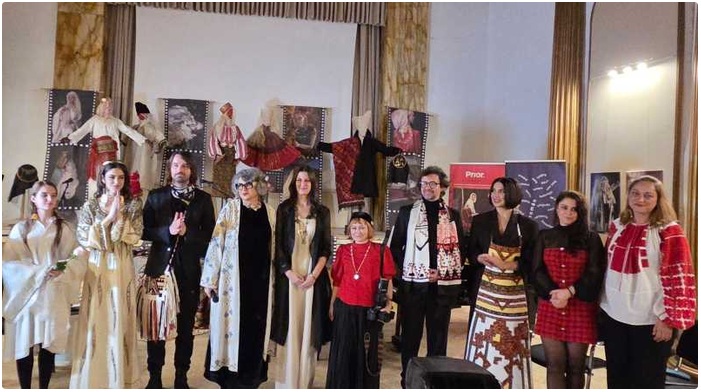
The Romanian Cultural Institute (ICS) hosted on November 16 the opening of the exhibition “The Hyperborean Gathering – Heritage as a Living Language,” an interdisciplinary curatorial project conceived by multidisciplinary artist Iraida Florea, founder of Hyperborean Folklore.
“The Hyperborean Gathering is the latest concept developed by the Hyperborean Folklore cultural diplomacy platform, which began as an interdisciplinary project. This is why we have all these disciplines, all these objects, all these old and new works here this evening, from the project I launched 10 years ago, when I returned to Romania. In its interdisciplinary approach, the Hyperborean Folklore project began its journey in the physical world through photography, through artistic photography, in order to present the Romanian traditional costume in a contemporary manner, using a language relevant to our times,” Iraida Florea told AGERPRES at the opening of the event.
Organised to mark UNESCO World Heritage Day in Romania, the event offers a contemporary perspective on Romanian cultural heritage through a dialogue between academic research, visual arts, fine art photography, traditional costume, contemporary jewellery, music and performance.
At the heart of the project is the album “Hyperborean Folklore – Anniversary Edition – A Tribute to Brancusi,” a visual synthesis of a decade of research and artistic creation, accompanied by an interdisciplinary Hyperborean Folklore installation. The installation brings together traditional Romanian costumes, fine art photography, film, sculpture and contemporary jewellery from the Hyfara Art Jewellery Collections, creating a visual narrative about the continuity, reinterpretation and transformation of ancestral symbols.
“The album brings together hundreds or even thousands of photographs that I have taken alongside several photographers, but most notably with my partner Irina Chira, who is also the co-author of this anniversary edition, a tribute to Brancusi. After all, we are still celebrating the Brancusi Year, marking 150 years since the birth of the father of modern art. The album features many of these Hyperborean photographs, in which traditional Romanian costume is presented both in its complete, authentic form, as passed down through the generations or preserved by princely households, which played an important role in promoting it, and in a more avant-garde form, more accessible to those who may still have a piece of traditional costume in the dowry chests inherited from their grandparents or parents,” the project initiator added.
Romanian Cultural Institute Vice-President and musician A.G. Weinberger said in a message sent to the organisers that “the exhibition is part of a broader artistic project which offers a contemporary and interdisciplinary perspective on Romanian cultural heritage.”
“In this encounter between tradition and contemporaneity, we are invited to view heritage not merely as an inheritance from the past, but also as a source of inspiration and creativity, as a living language open to interpretation and intercultural dialogue. This is a direction that the Romanian Cultural Institute encourages and supports, in keeping with its mission to promote the values of Romanian culture and make them known in a variety of international contexts,” A.G. Weinberger said.
Sculptor Vlad Dumitriu said the exhibition “The Hyperborean Gathering – Heritage as a Living Language” highlights the richness of colours and the complexity of traditional ornamentation, which he described as “perhaps the strongest source of inspiration for an artist’s imagination.”
Speaking about the Hyperborean Folklore project, which he developed together with Iraida Florea, Dumitriu said the Hyfara jewellery collection draws on geometric motifs found in traditional Romanian costumes.
“We did not simply reproduce these elements mechanically. After researching and filtering them through our own imagination, we reinterpreted them and created jewellery pieces that are not merely accessories, but genuine works of wearable art, capable of giving identity to those who wear them,” he said.
The opening programme also featured performances blending tradition and contemporary expression. Audiences enjoyed a classical recital by soprano Livia Delva, accompanied by pianist Diana Andrei, as well as an ethno-electronic rendition of “Lie, Ciocarlie” by composer Mihai Toma.
The exhibition opening also marked the public launch of “The Hyperborean Gathering – Six Thresholds Through the Magical Year of Romanians”, a travelling programme conceived as a nationwide journey of research, artistic creation and community engagement.
The final phase will be the Grand Hyperborean Gathering, a collective performance bringing together the communities and artists involved in the project.
The exhibition will remain open until 20 November.


