
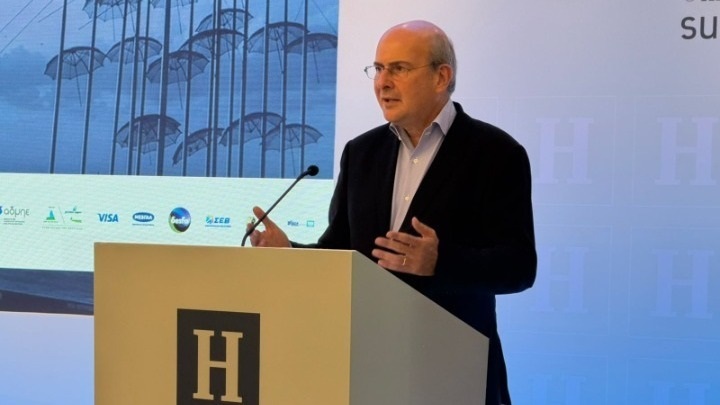
Deputy Prime Minister Kostis Hatzidakis, speaking on Friday at the 3rd Imerisia Economic Conference, entitled “Greece of Tomorrow – Redefining Growth in Southeast Europe”, being held in Thessaloniki, stressed that Greece’s goal was, by the end of the decade, not merely to try to close the gap with Europe’s more advanced countries but to be among them.
Hatzidakis added that Greece should have moved beyond the previous decade and be in the EU’s fast lane. He acknowledged that this was an ambitious goal but stressed that it was not unrealistic, given how much things had changed in recent years.
Hatzidakis stressed that in 2019 the main priority had been to return the economy to normality, with efforts focused on reducing public debt and unemployment, which stood at 18%, attracting investment, which had fallen to record lows, and restoring the country’s international credibility.
He observed that numerous objectives established at that time have now materialised, with the economy expanding at a rate surpassing the European average. Additionally, over 560,000 new jobs have been created, investment has been steadily increasing, and exports have reached unprecedented levels.
He noted that Greece had gone from being the “black sheep” of Europe to being recognised as a pillar of economic and political stability in a troubled region.
Hatzidakis said these national achievements were a source of satisfaction but also created a major obligation not to allow what had been achieved to be lost and, above all, to build on these successes to take the next major step.
As Hatzidakis stressed, New Democracy’s economic programme for Greece in 2030 will be based on three main pillars:
-First, fiscal credibility.
-Second, the productive transformation of the economy.
-Third, ensuring that growth reaches every Greek, wherever they live.


