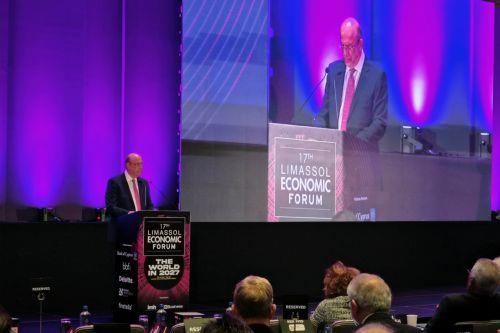
Finance Minister Makis Keravnos has called for greater flexibility in European economic governance to help economies respond to changing conditions, while stressing that fiscal stability must remain a central and non-negotiable objective of economic policy.
Addressing the 17th Limassol Economic Forum on Friday, Keravnos said Europe needed to simplify complex regulations, cut red tape and adapt its policy instruments to the economic cycle, warning that a rigid approach that failed to account for prevailing conditions could undermine the stability it sought to protect.
“Flexibility and a firm commitment to fiscal stability are not mutually exclusive,” he said. “On the contrary, rigidity and a monolithic approach that fail to take account of the economic conditions of each period may undermine the very stability they seek to secure,” he added.
Keravnos said the European Union faced a rapidly changing international environment shaped by geopolitical tensions, disruptions to international trade, energy challenges, technological advances and climate change.
These pressures were compounded by inflation and higher financing costs, which constrained governments and businesses and placed pressure on households and social cohesion, he said.
The Finance Minister argued that no country, however powerful, could address these challenges alone, stressing the importance of European cooperation in safeguarding economic stability and sustainable growth.
“The European Union is not and should not be, merely a common market or an economic union. It is a community of values, solidarity and shared responsibility. In times of uncertainty, European cooperation proves to be the most important instrument for preserving economic stability and social cohesion,” he said.
He said Europe needed to strengthen its competitiveness while reducing strategic dependencies, particularly in critical raw materials, technology and energy, without retreating from international trade and cooperation.
“The European response, therefore, clearly cannot be international isolation,” Keravnos said, adding that it should combine greater strategic autonomy with an open economy.
He also called for greater investment in innovation, research, artificial intelligence and workforce skills, while identifying the strengthening of the EU Single Market and the completion of the Savings and Investments Union as important steps towards improving Europe’s competitiveness.
Turning to Cyprus, Keravnos said the economy had demonstrated resilience in recent years, supported by prudent fiscal policy, the steady reduction of public debt, financial system stability and the implementation of reforms.
He also pointed out Cyprus’ role in shaping European policies during its Presidency of the Council of the EU, citing progress on competitiveness, capital market integration, the Multiannual Financial Framework and the digital euro.
The country’s geographical position in the Eastern Mediterranean also gave it strategic importance as a bridge between Europe and the wider Middle East, particularly in energy, transport, connectivity, security and investment, he said.