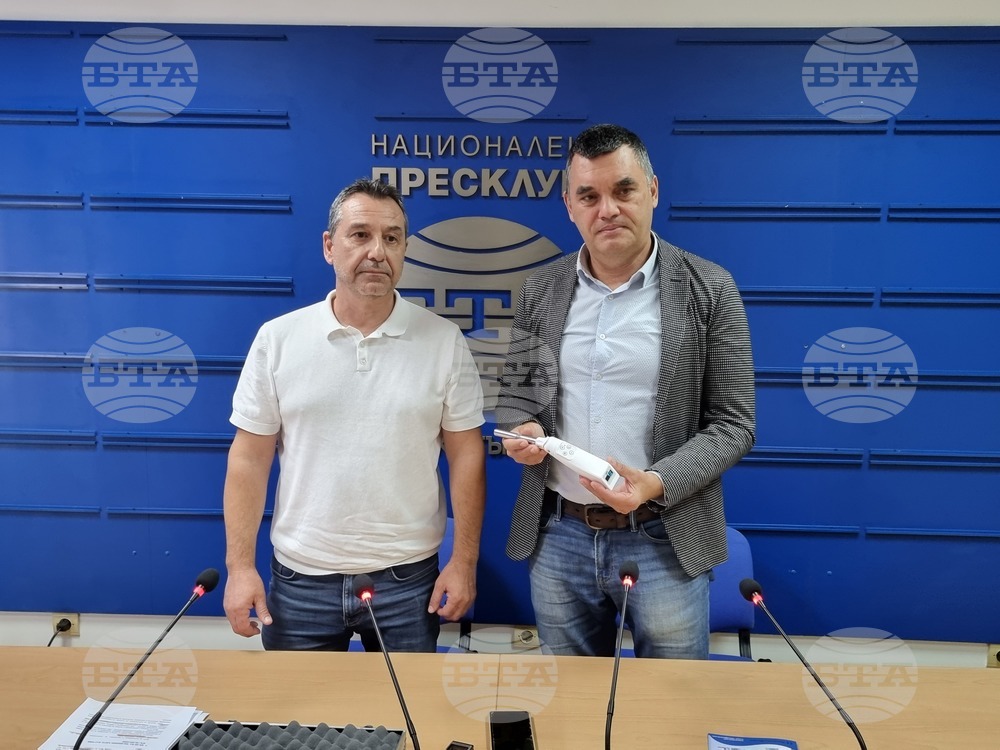
Bulgarian company Bultraf has developed a prototype portable gamma spectrometer designed to help surgeons locate sentinel lymph nodes during cancer operations, Bultraf General Manager Mihail Chenkov said at a news conference at the BTA National Press Club in Sofia on Monday.
Surgeon Svilen Maslyankov tested the prototype with breast cancer patients at Sofia’s Aleksandrovska University Hospital. He said the detector showed high sensitivity and accurately located sentinel lymph nodes. The device has a temperature sensor that automatically adjusts measurements and a movable arm to help surgeons reach difficult areas. Its USB port can transfer data to a computer and charge the battery.
Sentinel lymph node biopsy is used mainly in breast cancer and melanoma. It can allow less extensive surgery and reduce complications and recovery time, improving patients’ quality of life, Maslyankov said. The procedure has been standard practice in many countries for more than 20 years, but remains less widely used in Bulgarian oncology hospitals because imported devices are costly and too few surgeons are trained in the method, he added. Maslyankov said the Bulgarian prototype had improved specifications and could be offered at a substantially lower price.
Maslyankov plans to present the device’s capabilities and benefits to medical professionals at a scientific conference in 2027. He said around 4,000 cases of breast cancer are diagnosed in Bulgaria each year, including cases in women aged 23 to 29.
The prototype was developed under a project with a total budget around BGN 400,000 (EUR 204,516), co-funded under the Programme Competitiveness and Innovation in Enterprises 2021-2027. Preparatory work on the device took nearly three years.
The team wants to make the device available to Bulgarian medical institutions after completing the required certification and licensing procedures. It is intended mainly for sentinel lymph node biopsy in breast cancer and melanoma, as well as other cancers for which radioisotope localization can be used. The team estimates that it will be at least a year before production units can be offered.