
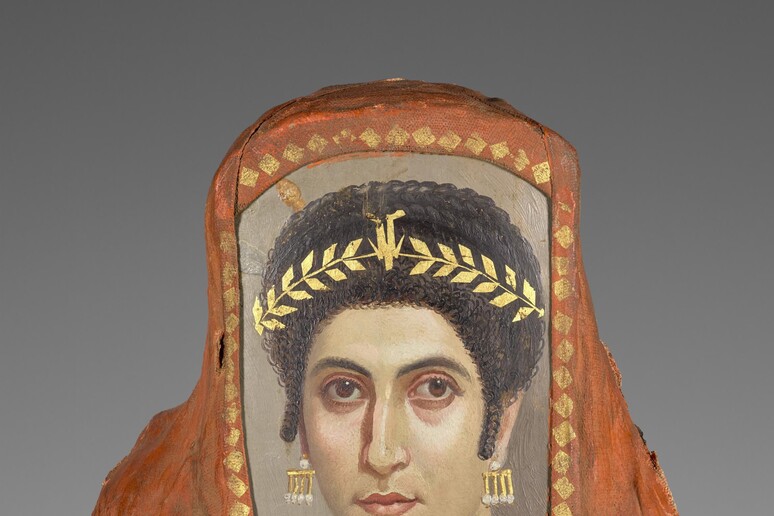
The biggest ever show in Italy of ancient Roman-Egyptian Fayum mummy portraits is set to wow visitors at Rome’s Ara Pacis museum from November 5 to May 2 next year.
If it is true that the eyes are the mirror of the soul—if the gaze is what best reveals our true nature—then there is a window into the lives of our ancestors that appears with striking clarity in the painted faces, often serving as funerary masks, that have come down to us from Roman-era Egypt.
These are gazes that captivated Henri Matisse, led Pablo Picasso to remark that “we have invented nothing since them,” and prompted Amedeo Modigliani to exclaim: “they… are more alive than those who look at them.” Alberto Giacometti also observed: “Those wide-open eyes are not looking at the outside world; they are looking at you, piercing right through you.” Now, these faces—more than two thousand years old—can be admired at the Ara Pacis, the museum aed around the Emperor August’s Altar of Peace.
The new display features over 110 works, including painted panels, shrouds, funerary masks, marble pieces, plaster casts, and ancient jewelry.
It is a unique treasure—and not just for Italy; there are fewer than a thousand of these distinctive Fayum portraits in existence worldwide, and about fifty of them have arrived in Rome for this exhibition.
For the first time, Egypt has granted access to nearly all the Fayum panels held in its own collections—pieces that had never before left Egyptian museums.
Among them is the so-called “Tondo of the Two Brothers,” one of the greatest masterpieces of ancient painting, which was restored in Egypt by Italian scholars.
Other works have arrived from the Louvre, including some exceptionally rare painted linen shrouds.
The exhibition at the Ara Pacis also features the portrait of Isidora—on loan from the Getty Museum—as well as portraits held by the Metropolitan Museum of Art.
In the case of Isidora, the work is so refined that it has given its anonymous creator their conventional name: the “Master of Isidora.” Also on display in Rome is the splendid Eirene—on loan from the Landesmuseum Württemberg in Stuttgart—whose name appears on the panel, accompanied by a prayer in which her loved ones entrust her soul to Osiris.
The exhibition further features a youthful face never before shown to the public; it recently emerged from excavations conducted in Egypt by an Italian archaeological mission from the University of Salento.
It is a portrait of a 14-year-old boy, discovered near a sacred site.
This was not a funerary image, but rather a painting created to celebrate his coming of age—a milestone marked by the cutting of the braid traditionally worn by children.
Remarkably, the boy’s severed braid—or perhaps that of another youth like him—was also found at the site, well-preserved by the sand.
These paintings were executed using the encaustic technique, which involves mixing pigments with beeswax.
This medium does not oxidize, lending the works a luster akin to that of oil paintings and, crucially, ensuring exceptional durability over time.
Thanks to this technique—widespread throughout the Eastern Mediterranean—and, above all, to Egypt’s unique climatic conditions, these artifacts have survived to the present day in vivid detail.
They represent the legacy of “one of the most sublime art forms of antiquity, yet one that has, in many instances, been lost,” notes Claudio Parisi Presicce, the Capitoline Superintendent and director of the Capitoline Museums, which contributed contemporary sculpted portraits from their own Roman collections to the exhibition.
As further evidence of the realistic intent behind these portraits, the exhibition also features jewelry from Pompeii and Herculaneum, allowing visitors to identify—within the archaeological record—some of the actual ornaments depicted in the paintings.
The exhibition journey itself begins with a comparison between two civilizations: the Roman and the Egyptian.
On one side, there is a Ptolemaic funerary mask from the Museo Barracco—a face that lacks individual features, with a fixed gaze intended to secure passage into the afterlife.
On the other side are marble portraits from the Capitoline Museums and the Centrale Montemartini.
It is precisely between these two poles that the Fayum portraits are situated—representing an encounter between different worlds, and between men and women who lived in the same era.


