
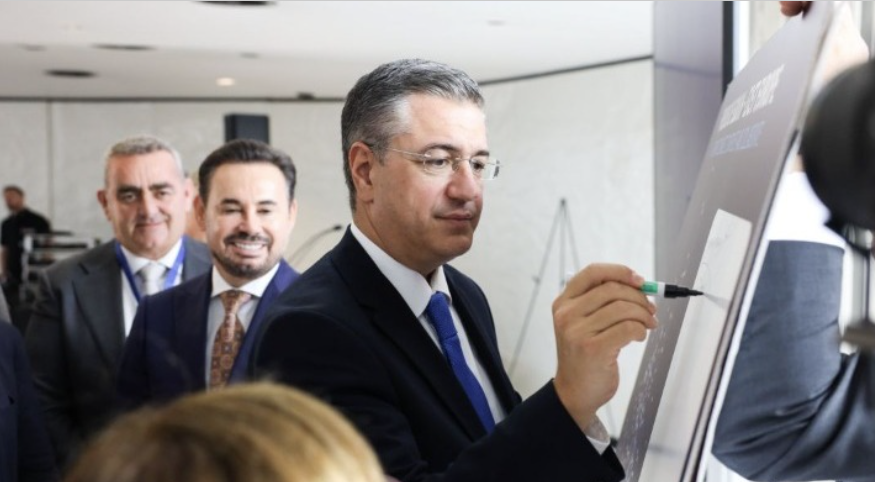
A joint Strategic Action Plan by Greece, Bulgaria and Romania for the Aegean-Black Sea road and rail corridor was presented and signed in Brussels during Connecting Europe Days 2026, marking a further step towards implementing the strategic transport link.
Commissioner for Sustainable Transport and Tourism Apostolos Tzitzikostas presented and signed the plan together with the infrastructure and transport ministers of the three countries linked by the corridor.
The plan was drawn up by the three EU member states with the Commissioner’s active support and sets out a roadmap for the projects required to make the road and rail link between Greece, Bulgaria and Romania a reality.
“ The Aegean-Black Sea road and rail corridor, linking Thessaloniki and Alexandroupolis with Bucharest via Sofia, is a major strategic project for Greece and Europe and one that I made a top priority from the moment I took office,” Tzitzikostas said.
“ With the presentation and signing of the Action Plan, we are taking another important step and moving into implementation,” he added.
The Commissioner said the project, due to be completed by 2040, was a leading example of European cooperation and “ not just another corridor”.
“ It is a road and rail connection that changes the scale and opportunities of northern Greece, which will acquire in practice, not just in words, the critical role of Europe’s gateway to the Balkans, the Mediterranean and South-East Europe,” he said.
Tzitzikostas said the project would provide a major boost to trade, exports, tourism and supply chains while also serving as a pillar of European defence and security.
“ With the Aegean-Black Sea corridor, we are making Greece stronger and Europe more connected, safer and more resilient,” he said.
“ Our goal is clear: a modern, fast and safe route from Thessaloniki to Bucharest via Sofia and then onwards to Ukraine and Moldova in the east and Central Europe in the west,” the Commissioner said.
He stressed that when transport connections in South-East Europe function well, the benefits extend far beyond national borders.
“ Supply chains become more reliable. Businesses gain access to more markets. Our citizens save time. And the European Union as a whole becomes stronger and more cohesive,” he said.
Tzitzikostas also welcomed the establishment of the European Parliament’s “ Friends of South-East Europe” initiative, saying both the Action Plan and the new initiative highlighted the value of cross-border cooperation and improved connectivity.
The initiative is intended as a platform for continued cooperation, political support and joint strategic planning aimed at keeping the region’s priorities high on the European agenda and ensuring that South-East Europe has a strong and constructive voice, particularly on connectivity issues.


